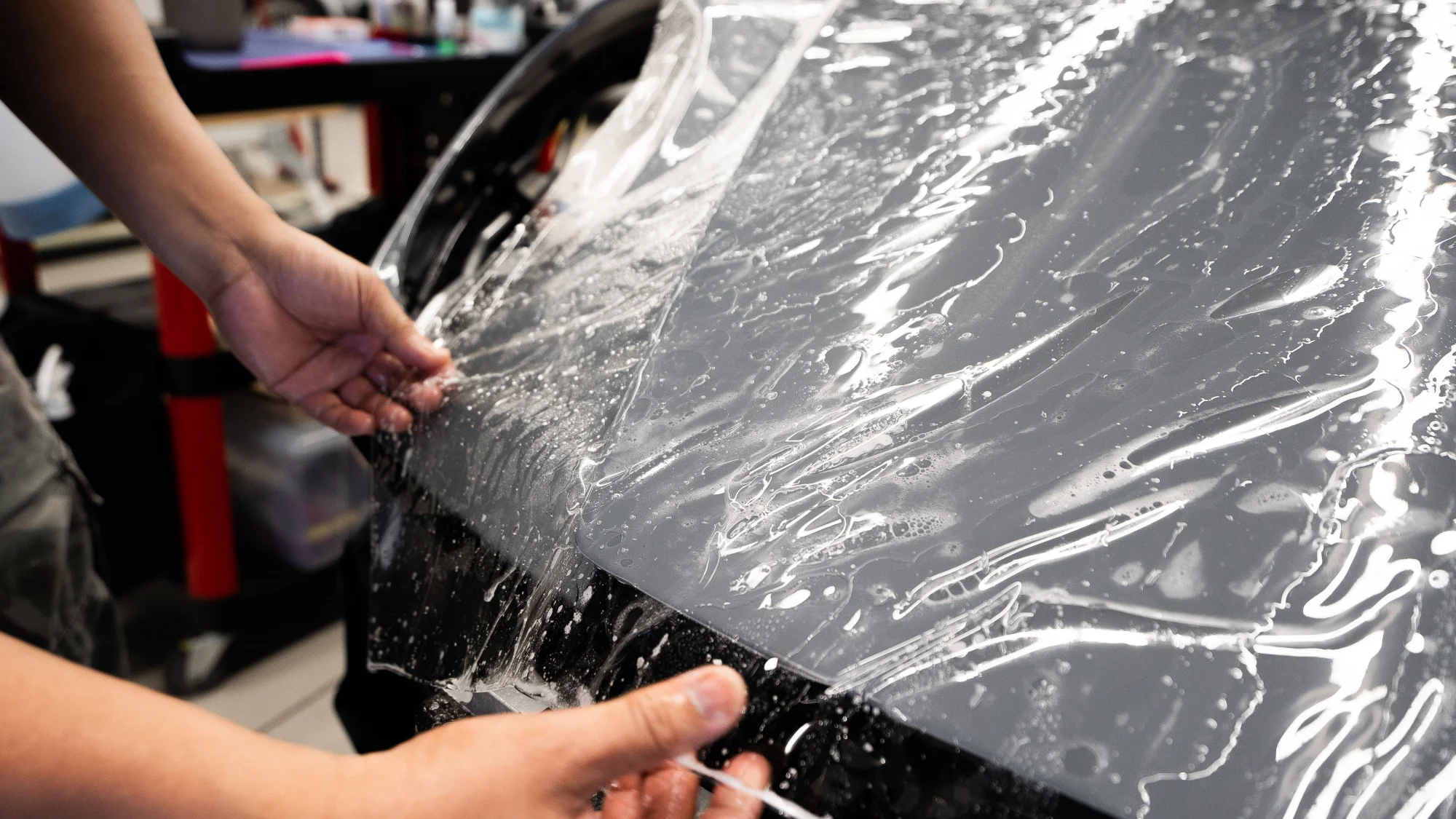
Paint protection film installation starts before the vehicle enters the workshop. A clean car is not automatically ready for film: the paintwork must be inspected, washed without leaving protective residues, and documented before handover. Paint protection film is a transparent protective layer applied to prepared painted panels. The owner’s job is to disclose the vehicle's condition and avoid unsuitable products; the installer’s job is to assess, decontaminate, correct where agreed, and prepare the surface for film installation.
What paint protection film preparation includes
Preparing for paint protection film means making the paintwork clean, visible, and honest before film installation. It does not mean trying to make defects disappear with wax, polish, or a showroom spray shortly before the appointment.
A proper preparation path separates owner tasks from installer tasks. Washing removes loose dirt and traffic film. Decontamination removes bonded contamination that washing cannot lift. Paint correction is polishing used to reduce or remove agreed paint defects before installation.
| Stage | Who handles it | Purpose |
|---|---|---|
| Visual paintwork inspection | Owner, then installer | Records existing chips, scratches, and previous repairs |
| Safe maintenance wash | Owner | Removes loose dirt without adding residue |
| Condition disclosure | Owner | Gives the installer a clear starting point |
| Chemical and mechanical decontamination | Installer | Removes bonded contamination from the paintwork |
| Paint correction, if agreed | Installer | Addresses visible defects before film installation |
| Final surface cleaning | Installer | Prepares panels and edges for adhesion assessment |
Use this order before booking or delivering the car:
- Inspect the paintwork in daylight and under workshop-style lighting where possible.
- Photograph visible paint defects and repaired areas.
- Wash the vehicle with residue-free products.
- Stop applying new paint-care products once the appointment is booked.
- Tell the installer what has been applied to the paintwork recently.
- Confirm the preparation scope in writing before handover.
A fresh wash helps the installer see the vehicle. It does not replace professional preparation. A works one way, B works differently: washing removes visible grime, while decontamination targets particles bonded to the surface.
No shortcuts.
Inspect the paintwork before booking PPF
Inspect the paintwork before booking PPF because film installation does not erase existing defects. A chip, scratch, stain, or uneven repair may remain visible beneath the film, particularly on light-coloured paintwork and sharply lit body panels.
An owner’s inspection is a condition record, not a professional diagnosis. Look carefully, take photographs, and disclose what you find. The installer should then assess the paintwork before confirming preparation work.
Paintwork inspection checklist
- Check the front bumper, bonnet, front fenders, mirrors, and headlights for stone chips.
- Inspect door edges, door cups, rocker panels, and the luggage-loading area for scratches.
- Look for swirl marks under direct light.
- Check for water spotting, stains, oxidation, or dull patches.
- Identify paintwork that appears repainted or colour-matched differently.
- Note dents, lacquer lifting, rough touch-up areas, and panel-edge damage.
- Photograph carbon-fibre components, painted trim, and complex vents before handover.
| Area requiring attention | What to look for | Why disclose it |
|---|---|---|
| Front bumper and bonnet | Chips, road rash, touch-up paint | Defects can remain visible after film installation |
| Door edges and handles | Scratches, paint wear | These areas often show prior contact damage |
| Rocker panels and rear arches | Sand marks, chips, staining | Low body areas collect road contamination |
| Panel gaps and edges | Dirt, polish residue, lifting paint | Edge condition affects preparation and finishing |
| Previous repair areas | Colour variation, texture changes | The installer needs to assess paintwork condition before work begins |
Can a film hide everything? No. It may soften the look of minor marks in some lighting, but it should never be ordered on the assumption that it will repair paintwork.
How to wash the car before PPF installation
Wash the car before PPF installation with a foam pre-wash, pH-neutral shampoo, the two-bucket method, and clean microfibre wash mitts. The aim is to remove loose dirt without adding waxes, sealants, or protective residue that complicates adhesion assessment.
Start with a foam pre-wash. Apply it to a cool vehicle, allow it to loosen dust and road film, then rinse thoroughly. In Dubai, sand can sit around badges, grilles, panel gaps, and lower body sections. Removing it before contact washing reduces the chance of dragging abrasive particles across the paintwork.
Owner wash sequence
| Step | Method | Avoid |
|---|---|---|
| Pre-wash | Foam and a thorough rinse | Rubbing dry dust or sand into the paintwork |
| Contact wash | pH-neutral shampoo with the two-bucket method | One bucket used for both rinsing and shampoo |
| Wash tool | Clean microfibre wash mitts | Dirty sponges, brushes, or worn mitts |
| Rinse | Flush seams, grilles, and panel gaps | Leaving shampoo in tight areas |
| Drying | Use clean microfibre drying towels | Spray waxes or drying aids |
The two-bucket method keeps the rinse water separate from the shampoo water. That separation matters because grit collected from the mitt otherwise returns to the paintwork on the next pass.
Dry the vehicle fully, including mirrors, grilles, badges, panel gaps, and lower trim. Water trapped in seams can carry dirt back onto prepared panels when the car is moved or opened.
After the wash, leave further cleaning to the installer. Don’t chase a last-minute shine. That is where well-meant mistakes begin.
Products to avoid before PPF installation
Avoid waxes, paint sealants, protective sprays, gloss enhancers, and oily dressings before PPF installation. These products can leave residue that affects adhesion assessment and forces the installer to spend more time identifying what is on the paintwork.
Adhesion refers to the film bonding correctly to a prepared surface. Residue affects adhesion through an invisible barrier between the paintwork and the installer’s final cleaning process. The issue is not simply whether the car looks clean.
| Product category | What to do before the appointment | Why it matters |
|---|---|---|
| Carnauba or synthetic wax | Do not apply it | Wax can leave a hydrophobic residue |
| Paint sealant | Do not apply it | Sealant residue may interfere with surface assessment |
| Protective spray | Do not use it as a drying aid or finish spray | Sprays can leave silicone or gloss-enhancing residue |
| Tyre and trim dressing | Keep it away from painted edges | Overspray can reach adjacent paintwork |
| Polish or glaze | Tell the installer if used recently | Oils and fillers can mask paint defects temporarily |
The safe rule is simple: once the appointment is confirmed, pause new paint-care products. Tell the installer about anything already applied, including wax, sealant, polish, spray protection, or detailing products used by another workshop.
A glossy finish can be misleading. Like a freshly mopped floor, it may look perfect until the light hits it from the side.
What professional PPF preparation includes
Professional PPF preparation should include an inspection, a clear scope, agreed surface work, film installation, finishing, and quality control. The owner should confirm which steps are included before booking, rather than assuming every quote covers the same preparation.
Decontamination refers to removing contamination that remains after washing. Chemical decontamination may address iron fallout, tar, or similar bonded residues. Mechanical decontamination uses a suitable method to remove remaining surface contamination before final cleaning.
Preparation work to confirm with the installer
| Procedure | What it addresses | What the owner should ask |
|---|---|---|
| Inspection and diagnostics | Paintwork condition before work begins | Will existing defects be photographed and recorded? |
| Chemical decontamination | Bonded chemical contamination | Is it included in the preparation scope? |
| Mechanical decontamination | Remaining bonded particles | Will the paintwork be checked for roughness? |
| Paint correction | Swirl marks, scratches, or other agreed defects | Is polishing needed before film installation? |
| Final surface cleaning | Remaining oils, dust, and residues | Is it the last stage before film application? |
| Quality control and delivery briefing | Finished film and visible edges | How will the vehicle be inspected before release? |
Paint correction is polishing performed to improve agreed paint defects before film installation. It should be discussed when scratches, swirl marks, haze, or prior repair work are visible. It is not the same service as film installation.
A sensible service process moves from inspection and diagnostics to a clear scope, estimate, and timeline, then installation and finishing, followed by quality control and a delivery briefing. DEIZ states that its work is completed under one roof rather than outsourced to contractors. Ask any PPF service who performs each stage. If a quote skips that conversation…
How to choose a PPF service in Dubai
Choose a PPF service in Dubai by checking evidence of preparation standards, installer training, vehicle-marque experience, and written scope. A polished reception area is not proof of surface preparation. The work happens in the wash bay, preparation area, and installation space.
DEIZ GARAGE describes itself as a Dubai workshop for luxury, sports, and high-performance vehicles. That positioning is useful only when matched by a provider’s documented process, recent vehicle examples, and a clear handover record.
Screening criteria before booking
| Check | What to verify | Why it matters |
|---|---|---|
| Reviews | Look for comments on preparation, edge finishing, and aftercare | Detail in reviews can reveal how work is managed |
| Certifications | Request current film-manufacturer training or certification records | Training supports consistent installation procedures |
| Marque experience | Ask for recent examples of your make and model | Complex panel shapes require model familiarity |
| Workshop inspection | Visit the installation area if possible | Clean, enclosed work areas reduce airborne dust during installation |
| Written scope | Confirm panels, preparation work, and quality-control steps | The scope prevents assumptions at handover |
For Porsche, Ferrari, and other performance-car owners, ask to see close-up examples of complex bumpers, side intakes, mirror housings, vents, and carbon-fibre sections. A wide photo of a completed car tells you less than a close view of an edge.
Dubai-specific checks before ordering PPF
Dubai owners should confirm how the PPF service will document paintwork condition, manage handover, and prepare vehicles exposed to road dust and heat. The local factor is practical: dust settles quickly, and a car delivered straight from a drive may carry contamination in gaps that looks harmless from a few steps away.
Request an in-person inspection before booking if the vehicle has recent paintwork, visible chips, matte paint, carbon-fibre panels, complex aerodynamic parts, or uncertain detailing history.
| Before handover | What to confirm |
|---|---|
| Paintwork record | Photographs of chips, scratches, repaired panels, and existing edge damage |
| Model-specific experience | Examples of comparable Porsche, Ferrari, or supercar bodywork |
| Scope | Covered panels, preparation procedures, and finishing approach |
| Workshop process | Who performs inspection, installation, and quality control |
| Delivery process | Final inspection and delivery briefing before accepting the car |
Heat is not a substitute for correct preparation. Neither is a hurried rinse before the appointment.
FAQ
Questions to ask before ordering PPF in Dubai
What should supercar owners in Dubai check before ordering PPF?
Supercar owners should check paintwork condition, the written coverage scope, the installer’s experience with complex bodywork, and the workshop’s preparation process. Ask how vents, carbon-fibre parts, sharp curves, and visible edges will be handled.
What should premium-car owners in Dubai check before ordering PPF?
Premium-car owners should request a documented paintwork inspection, confirm what preparation work is included, check installer certifications, and compare written scopes rather than comparing a single quoted figure.
What should Porsche and Ferrari owners check before ordering PPF?
Porsche and Ferrari owners should ask for recent marque-specific examples and confirm how the installer will assess chips, scratches, previous repairs, panel gaps, intakes, and paintwork around aerodynamic components.
What should be agreed before the vehicle is handed over?
Agree the paintwork condition record, covered panels, preparation procedures, installation timeline, quality-control process, and delivery briefing. A clear scope, estimate, and timeline gives both owner and installer the same reference point.
