A vinyl wrap is worth considering for a Porsche or Ferrari when the owner wants a reversible change of colour or finish and selects the installer on evidence, not social-media polish or a headline price. Start with the car's purpose. Decide whether vinyl wrap, PPF, or coloured PPF fits that purpose. Inspect the paint condition, request matching written quotes, and visit the workshop before handing over the keys. A lower figure may reflect less preparation, a different film, or reduced coverage. Those are different jobs. They are not competing offers.
Vinyl wrap is a colour or finish film applied over painted panels. PPF is a protective film selected primarily to protect the paint surface. Coloured PPF is protective film that also changes the visible colour or finish.
For a high-value car, the decision starts before the shortlist.
Is vinyl wrap the right choice for your Porsche or Ferrari?
Vinyl wrap suits an owner whose main aim is a visual change and who may later want to return the car to its original appearance. It can change gloss to satin, alter colour, add styling elements, or cover branding work. If stone-chip resistance and preservation of exposed paint come first, PPF or coloured PPF deserves closer attention before vinyl wrap is specified.
Wrapping and PPF can cover full vinyl wraps, styling wraps, branding wraps, and paint protection film. Painting follows another route. Factory-level finishing, custom paint concepts, and peelable paint solutions bring different permanence and preparation requirements.
The surface beneath the film determines much of the final appearance. Chips, dents, failing repairs, poor repainting, and residue do not disappear under film. They may remain visible, affect adhesion, or complicate removal later. Record the existing paint condition panel by panel before approving work.
Match the material to the ownership goal
A daily-driven Porsche may need a different answer from a Ferrari kept mainly for collection use. Regular road use puts more attention on exposed panels and practical cleaning. A collector car may place greater weight on preserving its present appearance and keeping a clear record of what was fitted and when.
Resale considerations matter too. A reversible visual change is easier to explain to a future buyer when installation records, film details, photographs of the original paint condition, and warranty documents are retained. The film itself does not create value. Clear paperwork makes the decision easier to understand.
Request an in-person assessment when the car has repaired panels, an uncertain paint history, existing film, lacquer damage, visible chips, or complex bodywork. This is not overcautious. It is where a generic estimate stops being useful.
How to assess a Porsche and Ferrari wrap installer
A suitable installer can show relevant Porsche or Ferrari work, identify the exact scope of each project, and explain how the car will be inspected, prepared, installed, checked, and handed back. A gallery of dramatic photographs does not establish that. Useful evidence is specific: vehicle model, visible panels, finish, close-up edge work, and a clear description of what was installed.
Porsche and Ferrari bodywork often combines tight shut lines, vents, sculpted bumpers, carbon-fibre elements, trim pieces, and exposed edges. Experience matters because the installation plan must account for those shapes before film is cut or stretched. Ask for work fr om the same model family wh ere possible. Generic "supercar" images are not enough.
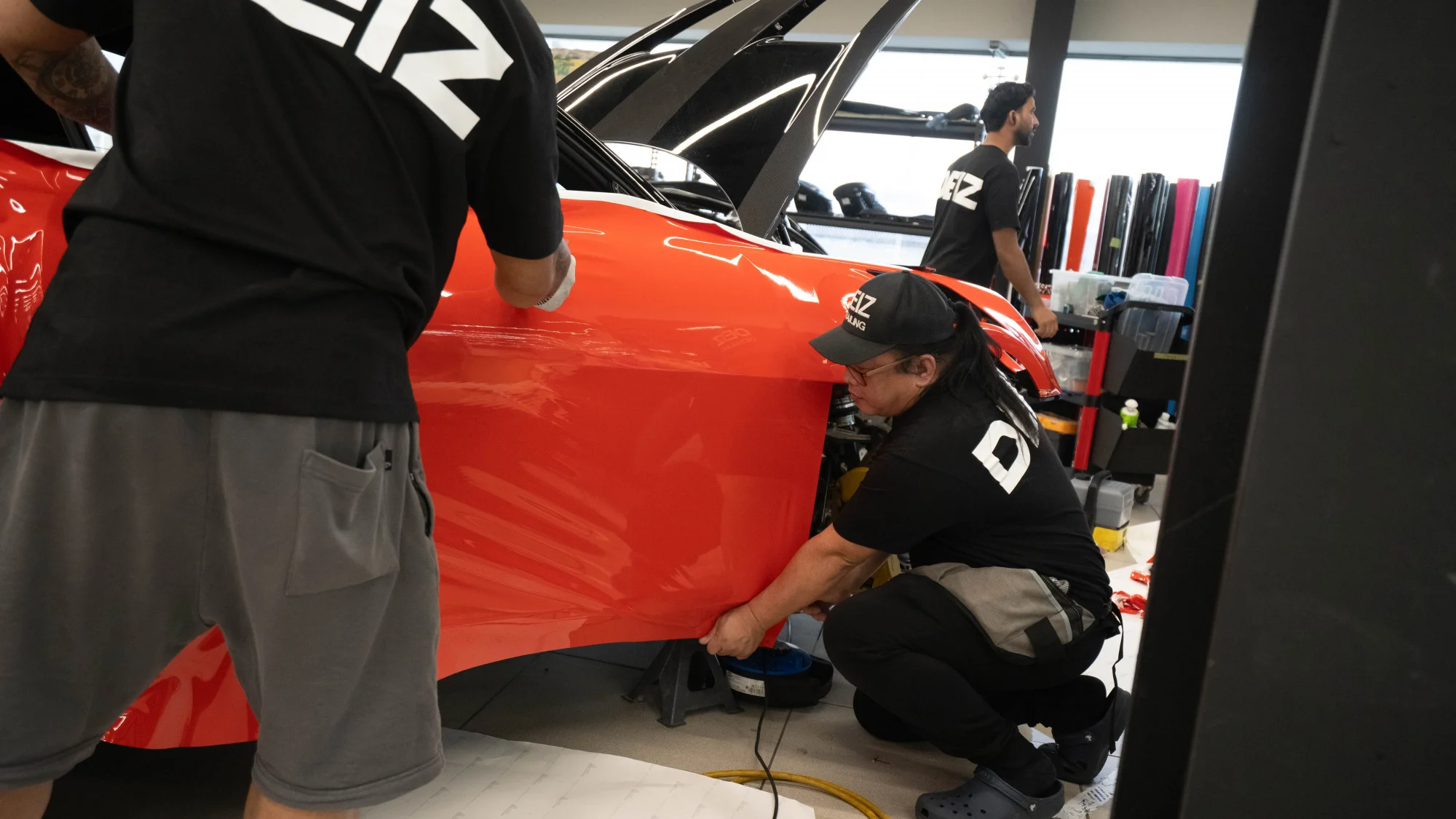
DEIZ GARAGE describes itself as a premium automotive workshop in Dubai for owners of luxury, sports, and high-performance vehicles. It says work is managed under one roof rather than outsourced to contractors. Its stated process includes inspection and diagnostics, a clear scope and estimate, production or installation, finishing, quality control, and a delivery briefing. Check those points during a visit. They are not a substitute for inspection.
What counts as useful installer evidence?
| Selection criterion | Evidence to request | What to verify |
|---|---|---|
| Porsche and Ferrari experience | Recent completed-project images and vehicle details | The model, panels covered, visible finish, and date of work |
| Portfolio quality | Close photographs of edges, handles, mirrors, bumpers, and shut lines | Consistent colour, tidy edge treatment, and no unexplained visible joins |
| Film affiliation | Manufacturer training record, installer listing, or approved-installer status | The issuer, current status, and product line covered |
| Installation team | Names or roles of the people who will work on the car | Who performs preparation, installation, inspection, and handover |
| Review quality | Detailed, recent reviews from identifiable customers | References to the work performed, vehicle type, communication, and follow-up |
| Workshop process | Written intake and handover process | Paint-condition record, scope confirmation, storage, and issue-reporting route |
A certification is useful only when it can be checked with the issuing manufacturer or training body. "Certified" without an issuer, course, date, or listing is just a word on a wall. The same rule applies to an "approved installer" statement. Ask who granted that status and which film product it covers.
Reviews need reading, not counting. A high rating can sit above vague comments. Look for recent reviews that describe a real job, the type of work, communication, or handover. Watch for posts that sound as if they came from the same script. One detailed account says more than a stack of star icons.
Ask for proof, not promises
Request evidence of relevant completed work before booking:
- Ask for images of the same Porsche or Ferrari model family, if available.
- Ask which panels were wrapped and whether trim or components were removed.
- Ask for close-ups of difficult areas, not only wide shots under bright lights.
- Ask whether the current installation team completed the work.
- Ask what happened at handover and how any post-installation concern was handled.
- Ask to see the written scope used for a comparable job, with customer details removed.
What does a clean photo prove? Sometimes very little. A glossy bumper can hide a poor edge as easily as a showroom mirror hides dust. Close inspection beats a flattering camera angle.
Vinyl wrap, PPF, or coloured PPF: choose the right material
Vinyl wrap, PPF, and coloured PPF solve different problems. Vinyl wrap is principally a visual-change product. PPF is principally a protective product. Coloured PPF combines a visible colour or finish change with a protection-led category. It should be assessed as its own material, not described as coloured vinyl.
A workshop may offer Premium PPF, Premium Color PPF, and Color Premium Vinyl. Those labels identify product categories in a quote. The owner should still request the precise manufacturer, product line, finish, and coverage area. Product naming affects comparability because two films described as "satin black" may differ in category, source, or installation scope.
| Material | Primary purpose | Visual-change capability | Protection focus | Best decision question |
|---|---|---|---|---|
| Vinyl wrap | Change colour or finish | High | Not the primary reason for selection | Do I want a different look that can later be removed? |
| PPF | Protect original paint | Usually limited by the specified product | Primary focus | Is preserving the current paint the main objective? |
| Coloured PPF | Change appearance while choosing a protection-led film | High, subject to product range | Primary focus alongside appearance | Do I need both a new finish and paint protection in one specified material? |
Vinyl wrap works one way, while PPF works differently. The first is selected for appearance. The second is selected for paint protection. Coloured PPF sits between those choices, but it is not interchangeable with either one.
What must appear in the material specification?
Before agreeing to installation, request these details in writing:
- Film manufacturer and exact product line.
- Film category: vinyl wrap, PPF, or coloured PPF.
- Colour, finish, and any texture named by the manufacturer.
- Coverage boundaries for each panel and visible area.
- Whether mirrors, handles, badges, trim, roof, door shuts, or aero parts are included.
- The planned position of seams and treatment of edges.
- The issuer and terms of the film manufacturer warranty.
- The issuer and terms of the installation warranty.
Do not accept "premium black film" as the full specification. Too much is left unsaid. A written product identifier gives the owner something concrete to check before the car enters the workshop.
How to compare vinyl wrap quotes
A vinyl wrap quote can be compared only when the vehicle, material, coverage, preparation, installation scope, and warranty terms match. Price alone tells you very little. One estimate may include edge finishing and component work, while another covers broad visible surfaces only. They can look similar on paper. They are not.
DEIZ GARAGE states that its prices are ladders by vehicle class rather than single numbers. Request the applicable class-specific starting price in writing, together with the exact vehicle model, material category, and scope of work. A starting price is not a final price for every Porsche or Ferrari. The written estimate should show where the car sits in the provider's vehicle-class ladder.
Porsche 911, Porsche 911 GT2, Porsche 911 GT3, Porsche Macan, Porsche Panamera, and Porsche Taycan are listed as Type 3 vehicles. Ferrari 296, Ferrari 488, Ferrari 812, Ferrari 12Cilindri, Ferrari Daytona SP3, Ferrari F8, Ferrari GTC4Lusso, Ferrari Monza SP, Ferrari Portofino, Ferrari Purosangue, Ferrari Roma, and Ferrari SF90 are listed as Type 5 vehicles. Vehicle class affects the estimate because body size, design, and installation scope can differ.
A class label is useful only if the quote states what it means for the specific car. Ask the workshop to identify the vehicle class on the written estimate. Then ask whether the figure changes for the selected material, colour, finish, coverage boundaries, component work, paint condition, or any planned rework. That is where a broad opening figure becomes a usable quote. No guesswork.
| Quote field | What it must state | Why it changes comparison |
|---|---|---|
| Vehicle | Exact model and relevant configuration | A quote must relate to the actual car, not just the marque |
| Film | Manufacturer, product line, finish, and category | Material descriptions must match before prices can be compared |
| Coverage | Full body, selected panels, trim, roof, or other named areas | "Full" can mean different things without boundaries |
| Preparation | Wash, decontamination, paint inspection, correction work, or exclusions | Existing paint condition can change the agreed work |
| Disassembly and reassembly | Components included and components excluded | This determines edge access and labour scope |
| Seams and edges | Planned seam locations and edge treatment | Visible finish depends on this detail |
| Timing | Estimated installation period and handover process | The owner needs a documented vehicle-return plan |
| Warranty | Film manufacturer warranty and installation warranty, separately | Different issuers may cover different issues |
| Price changes | Conditions that require a revised estimate | Avoids a surprise after the car is already in the workshop |
Premium PPF, Premium Color PPF, and Color Premium Vinyl should each be quoted by vehicle class, not as a single category figure. Ask for the starting point for the applicable class, then ask for the written estimate for your exact model and installation scope. Without that detail, category prices are only a rough signpost.
Reject vague scope early
Pause or reject any quote that does not name the film, define coverage, identify preparation work, and separate film manufacturer warranty from installation warranty. A lower figure without those details is not proof of value. It is an unanswered question.
This is where many owners get caught. They compare an itemised estimate with a broad verbal figure, then assume the difference is labour markup. Sometimes it is simply a different job.
How to verify film and installation scope
Film and installation scope should be verified before the car is left at the workshop. The owner needs to know what product will be fitted, where it begins and ends, which components are included, and what the finished edges should look like. Agreement before work starts prevents a later dispute about what "full wrap" was meant to include.
The workshop should record the condition of factory paint, existing paint condition, chips, scratches, repairs, existing PPF, and any existing vinyl wrap. This protects both sides. If an issue is visible at handover but present at intake, photographs and the written intake record should make that clear.
Pre-installation verification checklist
| Check | What to confirm before approval |
|---|---|
| Film identity | Manufacturer, product line, category, finish, and colour reference |
| Sample inspection | Colour, gloss level, texture, and finish consistency under workshop lighting |
| Coverage map | Every panel, trim item, roof section, mirror, and excluded area |
| Edge plan | Where film will terminate, tuck, or use a seam |
| Component work | Parts to be removed, loosened, retained, or excluded |
| Paint record | Dated photographs and written notes on existing paint condition |
| Existing materials | Any prior vinyl wrap, PPF, coating, repair, or residue |
| Handover standard | What the owner will inspect before accepting the car |
| Records supplied | Quote, final invoice, material details, care instructions, and warranty terms |
Inspect samples under more than one lighting condition if possible. A colour can look one way under workshop LEDs and another outside. That is not a defect by itself. It is a reason to approve the sample deliberately, rather than from a thumbnail on a phone.
Ask to see previous work on difficult areas: bumper curves, vents, mirror housings, door-handle recesses, diffuser sections, and sharp transitions between panels. Planning at those points affects finish consistency. A broad bonnet is easy to photograph. The awkward corners tell the story.
A stated warranty of up to 10 years depends on the work. It should never be treated as a blanket promise for every material, panel, use case, or issue. Ask what is covered, who issues the warranty, what exclusions apply, and how a concern must be reported.
Inspect the workshop before booking
A workshop visit should show a defined intake process, a controlled place to work on the vehicle, a method for storing it, and a clear handover routine. The aim is not to judge the decor. It is to see whether the car will be handled in a way that matches the quote and the value of the vehicle.
DEIZ GARAGE lists its location as Dubai, UAE, with Dubai as its primary service area and GCC services available on request. It lists opening hours of 10:00-19:00. Confirm those practical details directly when arranging an inspection or handover, because operating arrangements can change.
What to inspect in person
- Look for a clean, organised installation area rather than relying on reception photographs.
- Ask where intake photographs and paint-condition notes are created.
- Ask where the vehicle is stored before, during, and after installation.
- Ask who has access to the car and keys.
- Ask how the team protects interior surfaces, trim, wheels, and adjacent panels during work.
- Ask where quality control happens before delivery.
- Ask for the delivery briefing process and the route for reporting an issue after handover.
The workshop's stated process should be visible in practice: inspection and diagnostics, clear scope and estimate, production or installation and finishing, then quality control and a delivery briefing. If the person selling the job cannot explain who owns each stage, stop there.
Verify a Dubai or UAE provider beyond its feed
Use the legal business name shown on the quote and invoice. Check that it matches the workshop location, contact details, and payment entity. Request relevant trade documentation if you need it for your records. For claimed film affiliations, consult the material manufacturer's installer directory where one is available. You can also ask the manufacturer to confirm the stated status.
A claimed in-house operation deserves one plain question: "Which parts of this work leave the premises?" DEIZ GARAGE states that it does not outsource to contractors and has in-house production capability for custom forged wheels, high-performance downpipes, carbon-fibre or composite aero, and body elements. That does not decide whether it suits your car. It gives you specific points to inspect and ask about.
Shortlist providers as options, not endorsements. Arrange a visit, request a written scope, inspect relevant portfolio evidence, and compare like for like.
Pre-booking mistakes Porsche and Ferrari owners should avoid
The costly mistakes usually begin before installation. An owner accepts broad wording, skips the paint record, or treats a social-media reel as proof of workmanship. The fix is not complicated. It requires a slower decision.
What to ask before ordering
Ask questions that produce documents, product names, photographs, and named responsibilities. A useful answer can be checked later. A comforting answer often cannot.
Questions about the material
- What is the exact manufacturer and product line?
- Is this vinyl wrap, PPF, or coloured PPF?
- What is the approved sample for colour, gloss, texture, and finish?
- Is the quoted material available for inspection before installation?
- What film manufacturer warranty applies, and who issues it?
Questions about relevant experience
- Can you show completed Porsche or Ferrari projects with the vehicle model identified?
- Which members of the installation team worked on those projects?
- Can I see close-up images of edges, mirrors, bumpers, vents, and trim?
- What manufacturer training or installer status do you hold, and how can I verify it?
Questions about preparation and fitting
- How will you record existing paint condition before work starts?
- What preparation is included in the written scope?
- Which parts will be removed, loosened, or left in place?
- Where will seams be placed?
- How will exposed edges and difficult recesses be finished?
- What visible limitations should I expect on this specific car?
Questions about timeline, storage, and handover
- What is the written installation timeline?
- Where will the car be stored outside working hours?
- Who carries out quality control before delivery?
- What will we inspect together at handover?
- Which aftercare instructions will be supplied in writing?
- How do I report a concern after collection?
Ask for a clear scope, estimate, and timeline. It is the document that turns a sales conversation into an agreed installation scope.
FAQ
Is vinyl wrap worth it for a Porsche or Ferrari owner who wants a visual change?
Yes, if the owner wants a reversible colour or finish change and chooses a documented material and installation scope. It is less suitable when the main objective is paint protection, where PPF or coloured PPF may fit the brief better.
What risks should be discussed before vinyl wrap is applied?
Discuss existing paint condition, repaired panels, previous films, planned seams, edge locations, component handling, and removal expectations. The installer should document the vehicle's condition before work begins.
What aftercare instructions should the owner obtain at handover?
Obtain written cleaning guidance, instructions for inspecting edges and seams, details of any products to avoid, and the process for reporting a concern. Keep the final invoice with those instructions.
How should stated film lifespan and warranty terms be assessed?
Ask who issues each warranty, what material and installation issues it covers, what exclusions apply, and whether the stated term applies to your exact scope. A warranty stated as up to 10 years depends on the work.
What should the owner do if an issue appears after installation?
Photograph the issue promptly, keep the date and location clear, and contact the installer through the process stated in the handover documents. Do not rely on an informal verbal discussion alone.
Which records should be retained after handover?
Keep the itemised quote, final invoice, paint-condition record, material identification, warranty terms, aftercare instructions, and handover photographs. Those records make later questions far easier to resolve.
