A supercar scratch repair should be booked only after the damage, paint finish, protection layers, and workshop method are clear in writing.
A supercar scratch repair should be booked only after the damage, paint finish, protection layers, and workshop method are clear in writing. A light mark may need paint correction, while damage that reaches lower paint layers may require a paint repair or a wider panel process. The difference affects colour matching, drying time, protective-film replacement, and the final appearance under direct light. Before approving work in Dubai, provide clear images, identify the panel and finish, ask for the proposed repair method, and compare written scopes rather than choosing from a headline price.
Scratch repair is a service decision based on the depth and location of paint damage, not a blanket promise to remove every visible mark.
Paint finish refers to the surface appearance of the paint, such as gloss, matte, metallic, pearlescent, or a custom finish.
For Dubai bookings, confirm the workshop location, inspection process, and collection arrangements before approving the repair.
Classify the scratch before requesting a repair
The first booking question is simple: what layer appears to be affected? Record the panel, exact location, length, width, visible colour change, paint transfer, chips, and whether the mark catches a fingernail. Photos taken in daylight and under workshop lighting can show different things. Both matter.
A surface scratch is a light surface mark that appears limited to contamination, paint transfer, or the uppermost painted surface. A clear-coat scratch is a scratch in the clear coat, where lower paint-layer damage has not been established. A deep scratch is a deep paint scratch that may extend into the colour layer, primer, substrate, or an edge of the panel.
Don't diagnose by touch alone. A fingernail test can help frame the discussion, but it cannot establish the full repair scope on a pearlescent finish, a matte finish, a panel edge, or an area covered by PPF.
| Damage category | What to record before contacting a workshop | Repair-method category to ask the workshop to assess | When a remote estimate is not enough |
|---|---|---|---|
| Surface scratch | Visible mark, paint transfer, panel location, photos in direct and indirect light | Cleaning, decontamination, or measured paint correction | The mark changes appearance across the panel or sits near an edge |
| Clear-coat scratch | Whether a fingernail catches, whether the paint colour is unchanged, and prior paintwork on the panel | Local correction or a controlled polishing assessment | The mark is broad, appears through the finish, or follows a panel contour |
| Deep scratch | Exposed lower layer, chip, bare substrate, cracking, denting, or panel deformation | Paint repair, local refinishing assessment, blending assessment, or panel-level repair | Any exposed substrate, dent, crack, damaged edge, or uncertainty about paint layers |
Signs that move the decision to an in-person inspection
Ask for an in-person workshop assessment before authorising work when the scratch reaches a sharp body line, a carbon-fibre component, a bumper corner, a door edge, or a panel with visible previous repairs. These areas can make a local repair look obvious even when the mark itself is small.
A scratch beside PPF should also be inspected in person. The visible line may be in the film, in the paint beneath it, or in both. Those are different scopes.
Inspect the repaired panel under direct and shaded light to check colour, gloss, texture, and blending.
The mistake behind many poor bookings
The common belief is that every scratch should be polished first. That stops holding when the lower paint layers are affected. Paint correction works by refining an existing surface; paint repair deals with damage that cannot be corrected without adding or rebuilding material.
The damage type determines the repair conversation: a surface scratch may justify an assessment for correction, while a deep scratch may require paint repair and colour matching. Treating both as the same job can produce a quote that leaves out blending, protective-layer work, or final inspection.
Before sending photos, prepare this short list:
- Photograph the panel from close range and from several steps back.
- State whether the mark catches a fingernail.
- Identify the make, model, model year, and panel.
- State whether the vehicle has PPF or ceramic coating.
- Mention prior paintwork, wrapping, or repairs on the affected panel.
- Ask the workshop to state what it cannot confirm from photos.
That distinction matters because photographs cannot confirm paint-layer depth, prior repairs, or the condition beneath PPF.
Check experience with your supercar model and finish
A workshop should show experience relevant to your vehicle, panel, and paint finish before it proposes a repair method. Experience with a painted bumper is not automatically evidence of experience with your specific model family, a matte finish, or a multi-layer pearlescent finish.
Provide the vehicle identification details at the start. This reduces back-and-forth and gives the workshop a fair basis for its proposed scope.
| Vehicle information to provide | Why it affects the repair discussion | Evidence to ask the workshop for |
|---|---|---|
| Make, model, and model year | Panel construction, paint process, and available paint information can differ by model year | Comparable completed work on the same make, model, or model family |
| Affected panel and exact location | A flat door skin, bumper edge, and bonnet line can require different repair planning | Before-and-after records showing a comparable panel area |
| Paint code, if available | It gives the colour-matching process a starting point | How the workshop verifies the vehicle against the supplied code |
| Paint finish | Gloss, matte, metallic, pearlescent, and custom surfaces do not present the same repair questions | Examples of completed work with the same finish type |
| Existing PPF or ceramic coating | The protection layer can change the repair scope | A written explanation of removal, replacement, or reapplication steps |
The client's workshop data includes "factory-level finishing, custom paint concepts, peelable paint solutions." Those categories should lead to specific questions, not vague confidence. Ask which of those processes applies to your panel, who performs it, and how the finished area will be checked against adjacent paint.
The same applies to stated manufacturer experience. The workshop is "Certified for BMW, Mercedes, Porsche, Lamborghini." For a booking decision, ask for work that is comparable in model family and finish rather than assuming a badge alone answers every paint question.
Matte and pearlescent finishes need different questions
A matte finish should be discussed as a finish-specific repair, because gloss correction methods may change its appearance. Ask how the workshop will preserve the intended sheen, whether the affected section can be treated locally, and what visual comparison it will use at handover.
A pearlescent finish needs a colour-matching discussion that goes beyond the paint code. The appearance can shift with viewing angle and light direction. Ask whether the workshop expects blending into adjacent panels, how it will compare the repaired area under different lighting, and what happens if the appearance is not acceptable at inspection.
| Finish type | What changes in the discussion | Question to put in writing |
|---|---|---|
| Gloss finish | The workshop must distinguish between correctable surface damage and damage requiring paint repair | "Is the proposed method correction, paint repair, or both?" |
| Matte finish | Texture and sheen must remain consistent across the visible panel area | "How will you prevent a glossier or darker repaired patch?" |
| Pearlescent finish | Colour appearance can vary with angle and lighting | "How will colour matching and any adjacent-panel blending be assessed?" |
| Metallic or custom finish | Metallic orientation and custom paint concepts may affect local repair choices | "What comparison process will you use against the surrounding finish?" |
| Peelable paint solution | The repair may concern a removable paint layer rather than conventional paint | "Is the damage in the peelable layer, the underlying paint, or both?" |
Can a workshop show a beautiful Lamborghini but no comparable repair record for your finish? It can. That is not proof of a problem. It is a reason to ask a more precise question before authorising work.
Verify paint materials, colour matching, and repair conditions
The quote should identify the paint system, colour-matching process, repair environment, and drying or curing plan for any work that goes beyond a surface assessment. Paint colour matching is not a guarantee of an exact outcome. It is a documented process for bringing a repair into visual alignment with surrounding paint.
A paint system is the compatible group of products and procedures used for refinishing, including preparation materials, colour layers, clear coat, and curing requirements.
Ask the workshop to name the paint brand and paint system proposed for the work. A paint brand without the system details does not tell you how the products are intended to work together.
| Check before approval | What the workshop should explain | What belongs in the work order |
|---|---|---|
| Paint system | Brand, product family, and layers planned for the repair | The named paint system or refinish system |
| Colour matching | Paint-code review, vehicle inspection, test process, and adjacent-panel comparison | Colour-matching and blending scope, if applicable |
| Dust-controlled paint environment | Where painting will occur and how the repair area is protected from contamination | The stated paint environment for the repair scope |
| Drying or curing | How the workshop will dry or cure the repaired area before handover | The planned drying or curing stage |
| Final inspection | Lighting conditions and visual checks used before delivery | Quality-control steps and any handover briefing |
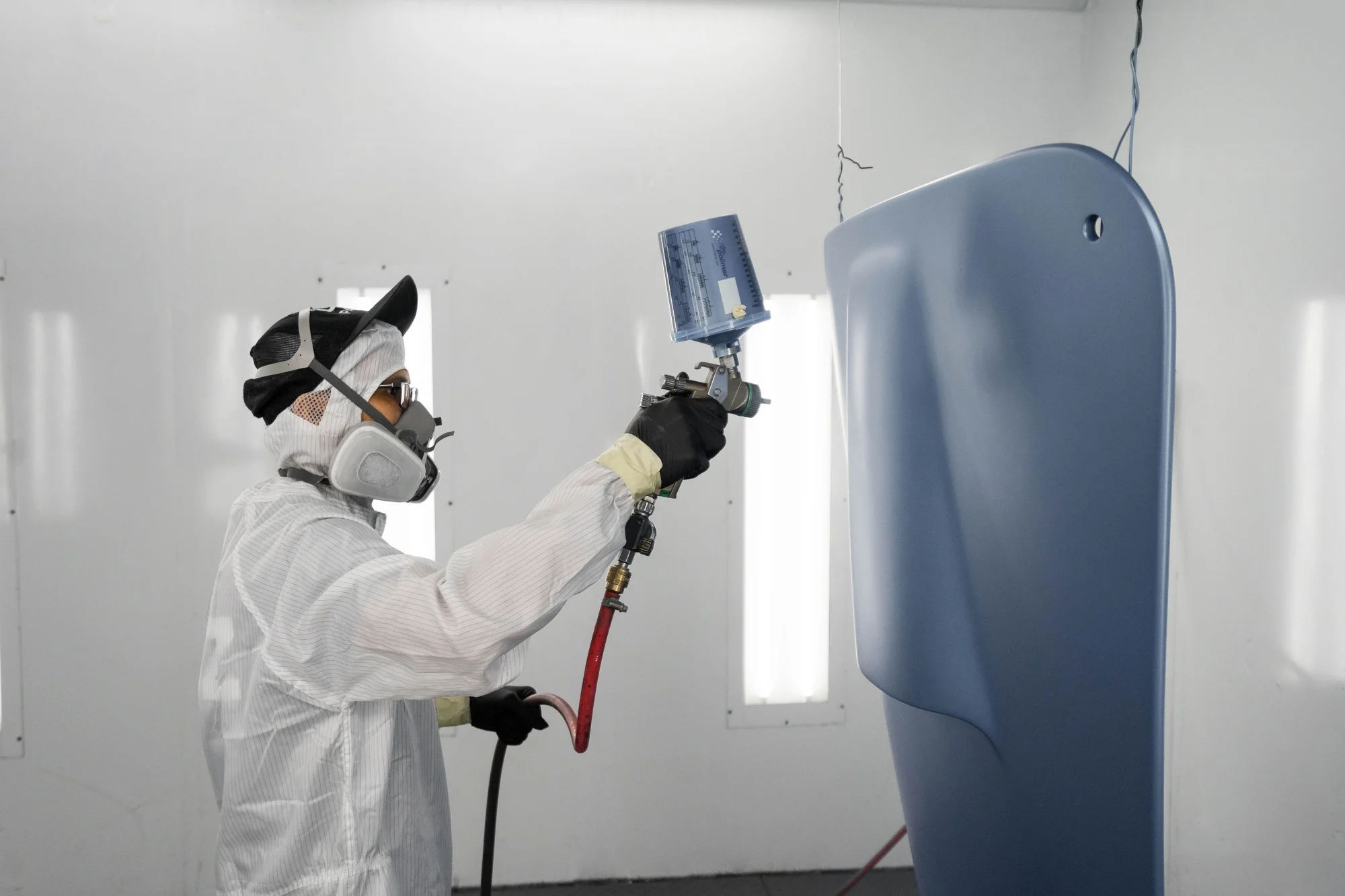
A dust-controlled paint environment is not a decorative phrase. Contamination can affect the appearance of a repaired panel, especially when viewed across a low bonnet or under direct sun. Ask where the paintwork will be completed and how the workshop separates preparation, paint application, and final inspection.
Drying and curing are different questions from a same-day handover promise. The workshop should explain the sequence it intends to use, the point at which the vehicle can be inspected, and any restrictions after collection. If the answer is simply "it will be ready," ask for the process behind that answer.
For protection-related correction work, the client data states: "Ceramic coating (GYEON, 10-year warranty), paint correction (RUPES tools)." RUPES tools identify a paint-correction tool family, not a universal method for every scratch. The method still depends on the established damage category and paint finish.
Confirm compatibility with PPF and ceramic coating
Tell the workshop about PPF and ceramic coating before it prepares the quote. PPF is paint protection film, a physical film layer. Ceramic coating is a liquid protective layer. They are not interchangeable, and they create different repair decisions.
PPF is paint protection film applied over painted surfaces as a separate physical layer.
Ceramic coating is a liquid protective layer applied to a prepared surface.
If the vehicle has PPF, state which panels are covered, whether the film is full-panel or partial, its age if known, and whether the scratch appears to be in the film or beneath it. If it has ceramic coating, disclose the coated panels, the product if known, and any recent coating work.
| Protective layer | Questions before ordering | Written scope to request |
|---|---|---|
| PPF | Is the scratch in the film, the paint, or both? Must the film be removed? Can it remain during the repair? Will a section or full panel require replacement? | Film inspection, removal if required, replacement area, finishing process, and handover check |
| Ceramic coating | Must the affected area be corrected before paint repair? Will the coating be removed from the repair area? Is reapplication included after the work? | Coating preparation, correction area, reapplication scope, and aftercare instructions |
| PPF plus ceramic coating | Which layer is being assessed first, and in what order will work take place? | The sequence of film, paint repair, coating work, and final inspection |
The client's workshop data states: "paint protection film. Warranty: up to 10 years (depends on the work)." It also states: "Warranty: «up to 10 years» / «до 10 лет» — everywhere, including wrapping and paintwork." Ask which written warranty terms apply to your exact work order. "Up to 10 years" is not the same as a fixed warranty period for every repair.
Protection changes the order of work. If PPF must be removed to assess paint damage, film replacement may become part of the repair scope. If ceramic coating is present, the repaired area may need preparation and reapplication after paint correction or paint repair. Confirm these steps in the written scope, because PPF removal, replacement, coating preparation, and reapplication may be separate chargeable items.
Check the workshop’s completed work and customer evidence
Workshop evidence should show work that is comparable in vehicle type, panel, finish, and repair category. Promotional images can show a polished result, but they may not show the original damage, paint condition, colour-matching process, or final panel comparison.
Ask for records that let you make a like-for-like comparison. A record of a gloss-black bumper correction is more relevant to a gloss-black bumper mark than an unrelated full-body wrap.
| Evidence to review | What it can verify | What it cannot verify on its own |
|---|---|---|
| Before-and-after photographs | Visible change, panel location, and presentation quality | Paint-layer depth, exact materials, or durability |
| Damage close-ups | Whether the starting defect resembles yours | The full repair scope without process notes |
| Completed-work records | Vehicle, panel, finish, and work performed when documented | How the repaired area looks over time |
| Customer reviews | Patterns in communication, booking, timing, and handover feedback | Whether a review relates to your paint finish |
| Written repair examples | Scope clarity and how a workshop describes exclusions | The outcome on your specific vehicle |
Review customer feedback beyond the workshop's own channels. Look for dates, model references, repair descriptions, images posted by the customer, and responses to issues. A high rating without detail is less useful than a smaller set of specific reviews describing panel work, communication, and collection inspection.
Ask direct questions if the available evidence is broad but not comparable:
- "Can you show a repair on a similar paint finish?"
- "Do you have completed work on this model family or panel type?"
- "What was the damage category in that example?"
- "What was included in the written repair scope?"
- "How was the final finish checked before delivery?"
A workshop does not need an identical case to be qualified. Still, it should be able to explain the proposed method, materials, repair limitations, and inspection criteria in writing.
Compare the quote, repair scope, and handover conditions
A useful quote identifies what will be assessed, repaired, replaced, and inspected. It should separate a preliminary estimate from a confirmed scope after inspection. This matters because a repair can expand once PPF, prior paintwork, panel damage, or colour matching is assessed in person.
The client process includes "Inspection & diagnostics", followed by "Clear scope, estimate, and timeline" and "Quality control + delivery briefing." Those are the stages to look for in a written ordering path.
| Quote field | What to compare between workshops | Issue to clarify before approval |
|---|---|---|
| Damage description | Surface scratch, clear-coat scratch, or deep scratch assessment | Does the stated category match the visible damage? |
| Panel and finish | Exact panel, paint finish, and paint colour information | Is the repair limited to one area or does it include adjacent work? |
| Repair method | Correction, paint repair, blending assessment, or panel-level process | Why is this method appropriate for the damage category? |
| Materials and paint system | Named paint system, preparation materials, PPF, or coating work | Are protection-layer tasks included or separate? |
| Repair conditions | Dust-controlled paint environment and drying or curing process | When can the vehicle be inspected and collected? |
| Handover conditions | Quality-control steps, delivery briefing, and warranty terms | What happens if a visible issue is found at collection? |
DEIZ GARAGE states that it does not outsource to contractors — everything is under one roof. If that is relevant to your decision, ask the workshop to identify who will perform each stage and where it will take place. The point is traceability, not a slogan.
DEIZ GARAGE also states that prices are ladders by vehicle class, not single numbers. Scratch-repair pricing is confirmed after inspection and is stated by vehicle class in the written DEIZ estimate. Review the written DEIZ scope by vehicle class, finish, repair method, and protection-layer work before approval. A lower initial figure can describe less work. A wider scope can include steps the first quote leaves outside the order.
At handover, inspect the vehicle in direct light and shaded light. Check the repaired area fr om close range and several metres away. Compare gloss, texture, colour appearance, panel edges, tape lines, dust marks, and the transition into adjacent paint. Confirm the condition of PPF and ceramic coating wh ere relevant.
Don't rush this part.
FAQ: What to check before ordering scratch repair for a supercar in Dubai
What should I check before ordering scratch repair for a supercar in Dubai?
Check the scratch category, your model and paint finish, the proposed repair method, paint system, colour-matching process, repair environment, drying plan, PPF or ceramic-coating compatibility, completed-work evidence, customer reviews, and the written quote.
How do I tell whether a scratch needs paint correction or paint repair?
A surface scratch or clear-coat scratch may be assessed for paint correction. A deep scratch, exposed lower layer, chip, crack, or dent needs an in-person assessment for paint repair or a broader panel process.
What details should I give a workshop before requesting a quote?
Provide the make, model, model year, affected panel, paint code if available, paint finish, clear photos, visible damage details, prior paintwork, PPF information, and ceramic-coating information.
Why does paint finish matter?
Paint finish determines the questions the workshop must answer. Matte finish repair must preserve sheen and texture. Pearlescent finish repair needs a clear colour-matching and adjacent-panel comparison process.
What should a written repair scope include?
It should identify the damage category, panels, finish, proposed method, paint system, colour-matching approach, repair conditions, PPF or ceramic-coating work, timing, quality control, and handover inspection.
Should I disclose PPF and ceramic coating before booking?
Yes. PPF and ceramic coating can change the repair sequence, materials, replacement work, and final appearance checks. Disclose both before the quote is prepared.
What to send when booking
Send enough information for the workshop to decide whether a remote estimate is reasonable or an inspection is needed. Clear information does not replace an inspection, but it prevents a vague booking request from becoming a vague repair scope.
Include:
- Clear photos of the full panel, the damage close-up, and the vehicle from several steps back.
- Make, model, model year, and affected panel.
- The exact location of the scratch, including proximity to an edge, body line, trim piece, or carbon-fibre component.
- Paint code, if available, and the stated paint finish.
- Whether the mark catches a fingernail, has paint transfer, exposes a lower layer, or is associated with a chip, crack, or dent.
- Details of previous paintwork, wrapping, or repairs on the affected panel.
- PPF details, including covered panels and whether the visible damage appears to be in the film.
- Ceramic-coating details, including the coated panels and product if known.
Ask DEIZ to confirm the inspection path, the written scope after assessment, the proposed repair method, and the expected handover checks before you approve the order.
