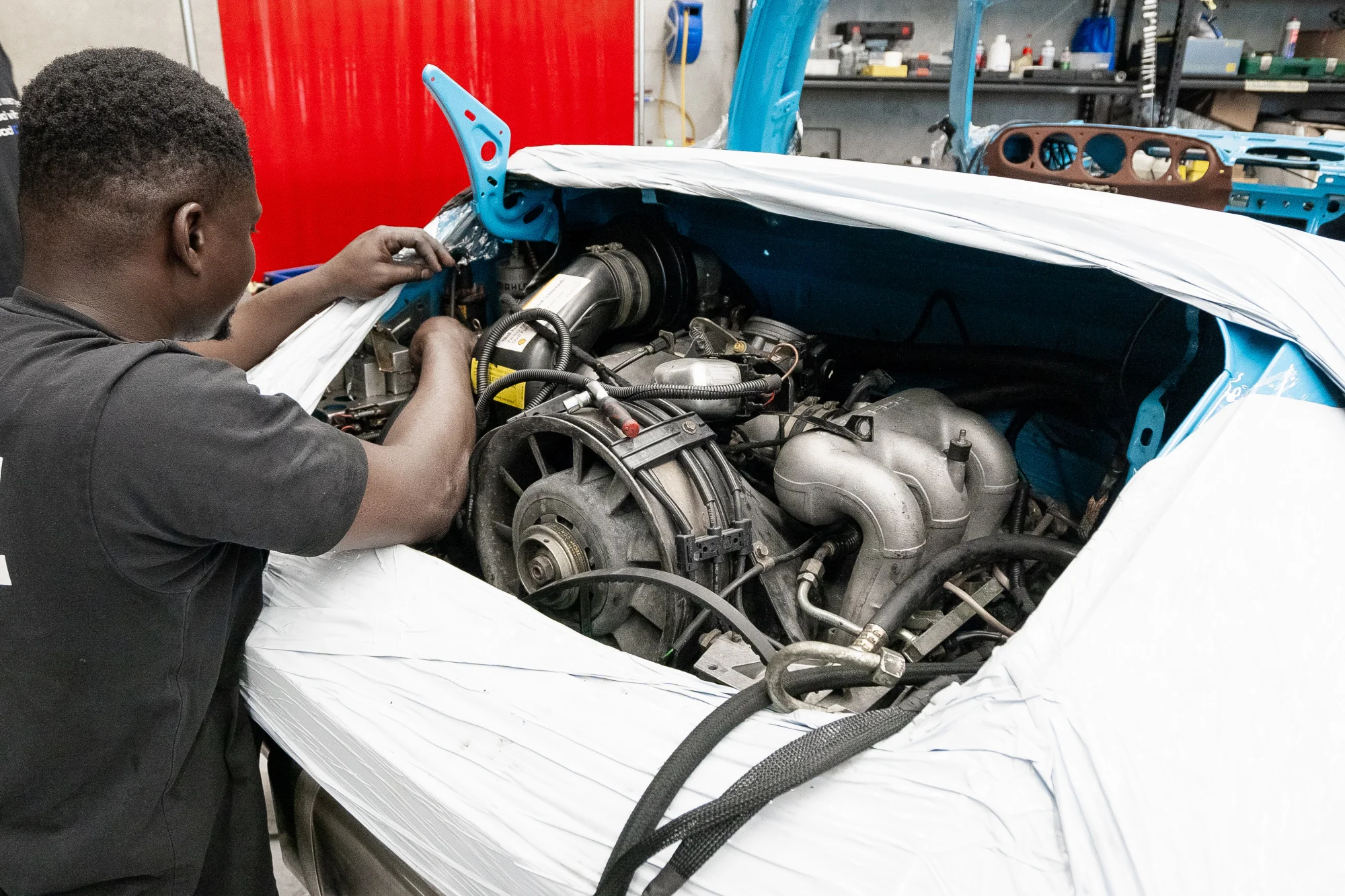
Automotive restoration starts with documenting the car's condition and defining the project goal, not with choosing an attractive workshop or ordering parts. The owner needs to decide what should be preserved, restored, or changed: factory specification, preserved original condition, period-correct specification, or an owner-selected configuration. In Dubai, age-related wear is compounded by heat, UV exposure, sand, humidity, and coastal storage. A mistake at the start becomes expensive because the workshop may assess one task and discover a very different one after disassembly.
Automotive restoration is a set of works that returns a vehicle to an agreed technical, visual, and historical condition. This guide concerns cars only: classic, premium, sports, collectible, and high-performance vehicles. It does not cover restoration of property, art, or medical procedures.
What automotive restoration means
Automotive restoration can include diagnostics, disassembly, repair or replacement of components, reassembly, and final quality control against an agreed specification. Its purpose is not limited to making a car look fresh. The result should be a clearly defined vehicle configuration, supported by documents and photographs from each stage.
A restoration scope is the agreed list of work, parts, materials, and result standards. It determines which components will be dismantled, what will be preserved, what will be replaced, and which modifications are acceptable.
A restoration project can vary in depth:
- preservation of original condition with minimal intervention;
- restoration to factory specification;
- restoration to a period-correct specification;
- an owner-selected specification with approved modifications;
- partial restoration of the body, interior, suspension, engine, or electrical systems.
Not every car needs a full project. A vehicle with a sound body and a damaged cabin may require cosmetic restoration only. Rare original trim can sometimes be more valuable when preserved than after an overly aggressive renewal.
An original part with honest signs of age can be better than a new part that does not match the specification. Restoration should not erase a car's history merely for gloss.
Signs a vehicle may need restoration
A vehicle may need restoration when its condition affects safety, preservation, value, or normal use. Exterior shine does not cancel problems beneath the surface. In Dubai, sand remains in seams and seals, while sunlight gradually damages plastic, leather, and paint.
The following signs require an initial assessment:
| Vehicle area | Signs | What to do before work begins |
|---|---|---|
| Body and paint | Blistering paint, corrosion, cracks, signs of poor previous repair, mismatched panel shades | Photograph the defects and do not order repainting before a body inspection |
| Chassis and underside | Corrosion, distorted mounting points, impact marks, damaged protection | Have the vehicle inspected on a lift by a specialist |
| Engine and transmission | Oil or coolant leaks, smoke, overheating, unstable running, unusual noises | Do not continue active use before diagnostics |
| Suspension and brakes | Pulling under braking, knocks, vibration, sagging suspension, uneven tyre wear | Mechanical diagnostics are needed before driving the car to the workshop |
| Interior | Cracked leather, fading, shrinking plastic, sagging headliner, damaged wood | Preserve samples of original materials and photograph their texture |
| Electrical systems | Inoperative instruments, unstable lighting, non-standard wiring, oxidised connectors | Check wiring and circuit protection before interior disassembly |
| Documents and completeness | No service history, missing original parts, unclear vehicle specification | Collect provenance evidence and list missing components |
Some signs mean the vehicle should not be driven to the workshop. These include damaged brake lines, major fuel leaks, unstable electrical systems, overheating, serious corrosion of load-bearing elements, and signs of flood damage.
The transport method affects the later restoration scope. A recovery truck with a suitable platform is often safer, even for a short trip to the workshop.
Why a surface inspection can mislead
Sand acts as an abrasive. It gets beneath mouldings, into window guides, door seals, and roof mechanisms. Because of this, a car that looks well cared for can still have wear in areas that are invisible during a routine wash.
Humidity works differently. Coastal air and long-term storage without control accelerate oxidation in connectors, fasteners, and metal interior components. The problem often becomes visible only during serious disassembly.
That is where surprises begin.
Do not confuse a clean body with a verified sound body. Fresh polishing can make defects less visible, but it does not change the condition of the metal beneath the paint.
Restoration versus maintenance and paint protection
Automotive restoration returns or preserves an agreed vehicle condition. Preventive maintenance keeps the vehicle serviceable in current use. Paint protection film and ceramic coating protect a prepared surface, but they do not correct the defects already present.
| Service | Main purpose | What it covers in principle | When to choose it |
|---|---|---|---|
| Automotive restoration | Return the vehicle to an agreed technical and visual condition | Bodywork, paint, interior, mechanical systems, electrical systems, trim, parts sourcing | When there is damage, age-related wear, loss of originality, or a need for deep reconstruction |
| Preventive maintenance | Keep the vehicle serviceable | Scheduled maintenance and advanced diagnostics according to manufacturer standards | When the vehicle is operational and requires scheduled work |
| Wrapping & PPF | Protect a prepared surface | Full vinyl wraps, styling wraps, branding wraps, paint protection film | After defects have been corrected and the surface is prepared |
| Ceramic coating | Reduce contamination impact and simplify care | Ceramic protection and paint preparation | After paint correction, when the surface already meets expectations |
Preventive maintenance works one way, automotive restoration works differently. Maintenance keeps the car in operating condition. Restoration addresses the effects of time, damage, or unsuccessful previous repairs.
Before maintenance, confirm the service schedule, service history, and materials to be used. The principle of "Genuine parts and manufacturer-approved lubricants only" applies to maintenance and repairs performed to manufacturer standards. It does not automatically make a restoration period-correct.
PPF will not conceal corrosion, paint cracks, or poor panel repair. Ceramic coating will not restore faded paint. It preserves the surface condition present at the time of application.
Paint protection is usually discussed after body and paint restoration. Not instead of it.
Detailing services may include GYEON ceramic coating with a 10-year product warranty, paint correction using RUPES tools, and interior heritage care with LEATHER MASTERS. These services address protection and appearance. They do not replace corrosion diagnostics, mechanical restoration, or electrical repair.
Assess the vehicle before agreeing the work
A condition assessment is needed before requesting an estimate. The owner can describe symptoms and collect evidence. A specialist should diagnose structural elements, the powertrain, electrical systems, brakes, and hidden body areas.
An initial inspection is a review of the vehicle's actual condition before the restoration scope is approved. It separates visible defects from hidden issues and prevents a project from being based on assumptions.
Initial assessment sequence
- Wash the vehicle without aggressive polishing and do not conceal defects with temporary products.
- Take photographs and video of the body, interior, underside, engine bay, and known problem areas.
- Record the VIN, mileage, engine number where marked, and registration details.
- List symptoms: leaks, noises, odours, dashboard warnings, and starting issues.
- Give the workshop the service history, records of previous body repairs, and modification details.
- Arrange inspection and diagnostics before approving the final restoration scope.
- Ask the workshop to separate confirmed defects, likely risks, and items that can be assessed only after disassembly.
| System | What the owner can check | What requires a specialist |
|---|---|---|
| Body | Chips, shade differences, panel gaps, visible corrosion | Paint thickness, hidden corrosion, body geometry |
| Interior | Leather wear, cracked plastic, trim completeness | Seat frames, wiring, mechanisms, climate-system condition |
| Engine | Fluid levels, smoke, odours, leaks, starting behaviour | Compression, system pressures, engine-management diagnostics, internal condition |
| Suspension and brakes | Squeaks, knocks, vibration, vehicle pull | Play in components, brake-line condition, dampers, mountings, geometry |
| Electrical systems | Dashboard warnings, inoperative functions | Connectors, wiring, control modules, charging system |
For a recently acquired vehicle, a separate report before work begins is useful. It creates a reference point: what was present at handover, which parts were missing, and which faults already existed.
Without that reference point, a discussion about a "new problem" can quickly become a dispute. Especially when the car has already been through several workshops.
Inspection and diagnostics should end with more than a general impression. A useful document separates a confirmed defect, a risk requiring disassembly, and a recommendation for the owner.
Gather records and document the vehicle
Records help preserve a car's provenance, identify correct parts, and avoid disputes about specification. For a collectible car, they are part of its value. For a modern sports car, they prevent its maintenance and repair history from being lost.
Prepare one digital archive and one folder with original documents, if they are available.
| Category | What to include |
|---|---|
| Identification | VIN, registration documents, specification details, component markings |
| Ownership and provenance | Previous invoices, purchase documents, auction materials, old photographs |
| Service history | Work orders, service book, diagnostic results, repair records |
| Body and paint | Information on repainting, accidents, panel replacement, insurance repairs where available |
| Parts | Part numbers, packaging, invoices, list of removed original components |
| Modifications | Information on installed components, suspension, exhaust, interior, aerodynamic, and electrical changes |
Photograph the car in daylight and indoors. Take general views, close-ups of defects, panel edges, wheels, glass, interior, luggage compartment, engine bay, underside, and factory tools.
A video of the engine starting and running can also be useful if starting it is safe. The recording should show the instruments, exhaust, lighting operation, and unusual sounds.
Collectors should store removed original parts with labels stating what the item is, where it was removed from, and its condition. Even a defective original component can be useful as a restoration pattern or evidence of factory specification.
Define the restoration scope
A clear restoration scope turns the phrase "I want to restore the car" into a task that can be assessed, phased, and controlled. Before disassembly, define what result will be accepted. Otherwise, each newly found defect can change the direction of the project.
Choose one primary reference point:
- preserved original condition;
- factory specification;
- period-correct specification;
- owner-selected specification.
Originality is conformity with an agreed reference point: the factory, period-correct, or preserved configuration of the vehicle. It cannot be discussed in abstract terms. For one model, factory paint colour and interior materials matter most. For another, the engine, wheels, instruments, or fastening type may be decisive.
What to record before disassembly
| Workstream | Owner decision |
|---|---|
| Mechanical restoration | Which assemblies will be rebuilt and which may be replaced |
| Body and paint restoration | Whether original panels will be retained, whether factory colour is required, and whether local repairs are acceptable |
| Interior | Which materials, stitching, shades, and trim elements are mandatory |
| Electrical systems | Whether an original layout is required or modern solutions are acceptable for reliability and safety |
| Parts and completeness | Which components must be original and which may be replaced with suitable alternatives |
| Modifications | Which changes are permitted and whether the vehicle can be returned to its original configuration |
Full Interior Reupholstery may include seats, door panels, the steering wheel, headliner, and trim. It is not the same as cleaning or applying a protective product to leather.
Modern modifications should be agreed separately. Carbon Fiber & Aero components may be used for defined weight, aerodynamic, or visual objectives, subject to the agreed restoration specification.
But this work changes the original specification. It should be the owner's decision, not an accidental result of parts sourcing.
Before disassembly, also decide what will happen to removed components. They can be retained, rebuilt, handed over to the owner, or replaced after written approval. For a rare car, this point can matter more than choosing a paint shade.
Set the budget, timeline, and approval process
A restoration estimate should be phased because part of a car's condition becomes visible only after disassembly. A fixed amount without conditions may look convenient, but it explains little in a complex project.
At DEIZ GARAGE, prices are presented as vehicle-class ladders rather than one figure for every car. A restoration project requires a separate estimate.
| Budget category | What to clarify before approval |
|---|---|
| Diagnostics and disassembly | What is included in the initial assessment and which work can be assessed only after opening components |
| Mechanical work | Which systems will be rebuilt and which parts may require sourcing or replacement |
| Body and paint | Metal repair scope, surface preparation, colour matching, finishing work |
| Interior and trim | Materials, samples, preservation of original elements, hand-finishing |
| Parts and logistics | Parts source, delivery timing, return conditions, shipping, and customs questions where applicable |
| Post-restoration protection | PPF, ceramic coating, storage, care, and periodic checks |
Ask for a "Clear scope, estimate, and timeline." This is a starting point, not a promise that changes are impossible. After disassembly, the workshop may find hidden corrosion, evidence of previous accident repair, non-original wiring, or unsuitable parts.
Each discovery should trigger written approval: a description of the problem, photographs, repair options, cost changes, and the impact on the timeline. "We will sort it out as we go" is convenient only until the first additional invoice arrives.
Which mistakes increase the budget
The most common mistake is approving cosmetic work before technical work. A new interior does not compensate for brake problems. Expensive paint does not correct corrosion beneath a panel.
Another mistake is failing to define the required level of originality. Sourcing a factory part, rebuilding an existing part, and fitting a modern replacement differ in cost, timing, and effect on the vehicle's value.
A project should not be left without approval points. The budget depends on decisions after diagnostics, disassembly, parts sourcing, bodywork, and final assembly. Without approvals, the budget grows because of unapproved work and changes to the restoration scope.
Ask the workshop to name control stages in advance. At each stage, the owner should receive photographs, a list of discovered issues, an updated budget, and a decision request.
Account for Dubai and UAE conditions
Preparing for automotive restoration in Dubai should account for climate, storage, transport, and possible registration requirements after modifications. High heat and UV exposure affect paint, plastic, rubber, leather, and adhesive bonds. Sand accelerates wear in moving components and seals. Humidity and coastal proximity increase the risk of oxidation in metal and electrical components.
After restoration, discuss storage conditions with the workshop: indoor space, dust control, seal condition, battery charge, tyre pressure, and inspection intervals. A car kept outdoors for months ages differently from one stored in a dry enclosed space.
This also affects the order of work. It makes little sense to restore an interior carefully if the car will then remain in direct sunlight with damaged seals. The materials will again suffer from heat, dust, and humidity.
Paint protection should also be selected for a defined purpose. PPF can help preserve a prepared surface from part of the wear associated with normal use. Ceramic coating does not prevent abrasion from sand or eliminate heat-related ageing of the underlying materials.
What to verify before handing over the vehicle
- Confirm with the insurer how placing the vehicle in a workshop affects the current policy conditions.
- Check whether separate steps are required after changes to construction, colour, powertrain, or other vehicle characteristics.
- If importing a vehicle or parts, clarify applicable requirements with the relevant authorities in advance.
- Agree storage conditions and transport method before delivery to the workshop.
- For sanitary, environmental, or municipal questions, consult official guidance, including Dubai Municipality where the matter falls within its remit.
Do not assume that every modification requires the same approvals. Requirements depend on the type of work, vehicle status, insurance coverage, and applicable rules. Each case should be checked individually.
Choose a restoration workshop in Dubai
A suitable workshop should have experience with your vehicle type and your restoration scope. Experience with modern luxury vehicles does not automatically mean experience with rare classic models. The reverse is also true.
DEIZ GARAGE provides diagnostics, planning, manufacturing, installation, finishing, and final quality control for luxury, sports, and high-performance vehicles in Dubai. Its documented workflow covers production, installation, finishing, quality control, and a delivery briefing.
DEIZ GARAGE is certified for BMW, Mercedes, Porsche, and Lamborghini. For owners of these marques, that is relevant information. It does not replace questions about the specific model, model generation, and comparable completed projects.
| Selection criterion | What to ask the workshop |
|---|---|
| Vehicle experience | Whether it has completed projects involving the same make, model, generation, and powertrain type |
| Diagnostics | How the inspection is carried out and which findings are documented before disassembly |
| Body and paint restoration | Which operations are completed on site and how preparation and finishing are checked |
| Interior and trim | Whether material samples are available and how original conformity is agreed |
| Parts | Who sources components, how provenance is verified, and who approves substitutions |
| Documentation | Whether stage photographs, reports, and a list of used parts are provided |
| Communication | Who manages the project, how often updates are issued, and how changes are approved |
| Warranty terms | Which work is covered, what limitations apply, and how a warranty request is handled |
| Subcontracting | Which operations are performed outside the workshop and who is responsible for final quality control |
DEIZ GARAGE states that its work follows the sequence "Production / installation / finishing", followed by "Quality control + delivery briefing". It also states that work is not outsourced to contractors and is carried out under one roof.
For the owner, this means one point of responsibility. The work scope, materials, approval procedure, and handover terms should still be written into the work order.
Before handing over the vehicle, the document should state:
- the vehicle condition at acceptance;
- the agreed restoration scope;
- known defects and risks;
- the process for approving additional work;
- storage and transport arrangements;
- the payment schedule;
- the procedure for handing over removed original parts;
- final acceptance conditions.
A good question is simple: who makes the decision if a new issue is found after disassembly? The answer should be in writing. Otherwise, decisions may be made without the owner, or the vehicle may remain in the workshop while approval is delayed.
Final check before the project starts
Before leaving the vehicle with the workshop, check one thing: will you be able to explain several months later exactly what you ordered and why each important decision was made?
If the answer is yes, the project is prepared. You have a pre-work condition record, a clear objective, documents, a photo archive, a list of original parts, an initial inspection, and rules for approving changes. Then professional work can begin, rather than guesswork.
FAQ
How should I prepare a car for restoration?
First document the vehicle with photographs and video, collect records, describe symptoms, and define the intended result. Then arrange diagnostics before approving the full restoration scope.
Which signs show that a car may need restoration?
Corrosion, paint cracks, evidence of old body repairs, brake, suspension, engine, electrical, or interior problems, and missing original components can indicate a need for restoration.
Does the vehicle need to be drivable?
No. A vehicle can arrive on a recovery truck. If there are brake, fuel-system, overheating, structural, or electrical problems, platform transport is safer than driving it.
Which documents may a workshop need?
Provide the VIN, registration documents, service history, repair and modification records, specification details, photographs, and a list of missing or removed parts.
How does restoration differ from maintenance?
Preventive maintenance keeps a vehicle serviceable according to its schedule. Automotive restoration returns an agreed technical, visual, or historical condition.
Can PPF or ceramic coating replace restoration?
No. PPF and ceramic coating protect a prepared surface. They do not correct corrosion, body damage, faded paint, mechanical faults, or deteriorated interior materials.
When should registration, insurance, storage, and transport be discussed in Dubai?
Discuss them before work begins. These questions are especially relevant when the project includes changes to construction, colour, powertrain, vehicle transport, or long-term storage.
What should I ask a Dubai restoration workshop before handing over the car?
Ask about experience with your model, diagnostics, parts sourcing, work performed in-house, photo reporting, approval of additional costs, storage conditions, warranty terms, and final acceptance.
Which warranty terms does DEIZ GARAGE state?
Wrapping & PPF may carry a warranty of up to 10 years, depending on the work; confirm the applicable terms in the work order. GYEON ceramic coating has a separate 10-year product warranty where that service is selected.
When can I contact DEIZ GARAGE?
The stated opening hours are 10:00 – 19:00. To begin, provide the vehicle make, model, VIN, current condition, photographs, service records, and any known modifications. Arrange an inspection, receive an initial scope and estimate, and approve any additional work in writing before it proceeds.
