Choose a scratch repair service for BMW and Mercedes based on three factors, not the lowest number in a message: an accurate assessment of the damage, an appropriate repair method, and documented results. A mark in the clear coat may be reduced through polishing. Damage that reaches primer or metal requires a different process, surface preparation, and repainting. The same defect can appear minor in a photograph yet prove deeper during inspection.
Scratch repair is the restoration of paintwork after local damage, with the method selected according to the depth, area, and location of the defect.
Clear coat is the transparent upper layer of the finish that provides gloss and protects the colour layer.
For BMW and Mercedes, colour matching, control of the transition into adjacent areas, panel condition, and final finish all matter. Good work does not automatically mean repainting the entire vehicle. But a promise to "remove any scratch in one visit" without inspection means very little.
Inspection first. Then the decision.
Assess the scratch before choosing a repair method
Choosing a workshop starts with understanding the type of damage. An owner does not need to identify the paint chemistry or measure coating thickness, but can describe the defect clearly enough for a workshop to propose an inspection and an appropriate scope of work rather than an arbitrary price.
A superficial mark is often visible at an angle or in sunlight, but does not alter the panel colour. If a fingernail does not catch on the line, the damage may be limited to the clear coat. If another colour, a dull strip, primer, or metal is visible, polishing is no longer sufficient.
Paint correction is machine polishing used to reduce or remove defects in the clear coat. It is not panel repainting.
| Damage type | Visible signs | Possible repair scope | What to ask the workshop |
|---|---|---|---|
| Superficial mark | Visible in side lighting, cannot be felt with a fingernail | Polishing | How will the condition of the clear coat be assessed? |
| Scratch in the colour layer | Fingernail catches, a differently coloured line is visible | SMART repair or localised repainting | Will the repair remain within one defined area? |
| Deep scratch | Primer, plastic, or metal is visible | Localised repainting or full-panel repainting | Are priming, metal protection, and blending required? |
| Panel-wide damage | Several scratches, chips, scuffing, or deformation | Full-panel repainting | Why would localised repair not provide a stable result? |
Do not send only one close-up image. Initial assessment requires photographs from a distance, an overall view of the panel, an image in daylight, and an image taken at an angle. State the BMW or Mercedes model, body colour, damage location, and whether the area has had previous bodywork.
When photographs do not replace an inspection
Remote assessment is useful as a first step, but not as a final decision. An in-person inspection is required when the scratch runs across a panel edge, sits near a camera, parking sensor, radar, moulding, door handle, or paint-protection film. It is also required when the damage crosses a plastic bumper and an adjacent painted metal panel.
The condition of neighbouring panels also matters. Body colour changes through paint age, previous repainting, sun exposure, and clear-coat condition. For that reason, paint matching depends on more than the vehicle paint code. It depends on the actual appearance of the panel.
Do not rush it.
What to record before contacting a workshop
- Name the damaged part: door, fender, bumper, bonnet, or sill.
- State the scratch location: panel surface, body line, edge, sensor area, or panel joint.
- Give an approximate length and width without trying to calculate an exact price.
- Record visible layers: clear coat, colour layer, primer, plastic, or metal.
- Note dents, cracks, chips, or signs of corrosion.
- Mention previous repainting, wrapping, or paint-protection film if known.
This information reduces guesswork. Guesswork in body repair often becomes additional work after the vehicle has been accepted.
Match the repair method to scratch type and Dubai conditions
The appropriate method is determined by damage depth and repair area, not by a desire to keep the painted area as small as possible at any cost. Polishing works on the clear coat. SMART repair suits a confined area. Localised repainting is used where the colour layer is damaged. Full-panel repainting is required when a local repair boundary would remain visible or when the damage is too extensive.
SMART repair is a local repair of a limited area involving preparation, painting, and finish restoration without automatically repainting the whole panel.
| Method | When it suits the damage | When it does not suit the damage | What to ask in Dubai |
|---|---|---|---|
| Polishing | The mark is limited to the clear coat | The colour layer, primer, plastic, or metal is visible | How much clear coat will be removed during processing? |
| SMART repair | Isolated damage in a suitable area of the panel | The scratch crosses an edge, body line, or a large area | Where will the repair area end? |
| Localised repainting | Paint damage is limited to a defined area | An invisible transition in colour and clear coat cannot be achieved | How will blending and colour control be performed? |
| Full-panel repainting | Damage is deep, long, or technically complex | There is no basis for it if the defect is genuinely limited to the clear coat | Which preparation and painting operations are included? |
A common assumption is that local repair is always preferable to full-panel repainting. It is not. Localised work preserves more original paint, but it should not leave a visible boundary, inconsistent gloss, or unstable colour. Full-panel repainting serves a different purpose: it produces one consistent finish across the part where a localised area would remain noticeable.
Why Dubai conditions affect the process
Heat, solar exposure, airborne dust, and temperature variation in Dubai affect surface preparation, curing, paint stability, and aftercare. Colour stability depends on correct preparation, compatible materials, and adherence to the paint-system process.
In Dubai, airborne dust is a key contamination risk during paint preparation and application, so the repair environment and surface-cleaning process should be confirmed.
Ask the workshop for a clear answer to these questions:
- In what type of area will the panel be prepared and painted?
- How is surface cleanliness controlled before materials are applied?
- How will the paint be cured and allowed to stabilise?
- When can the vehicle return to normal use?
- What restrictions apply to washing and care after handover?
- How will the colour be checked in daylight?
Paint-protection film and ceramic coating serve different purposes. Paint-protection film can protect a repaired painted surface against future exposure. Ceramic coating can make maintenance easier and add a protective layer. Ceramic coating does not repair an existing scratch.
Paint repair restores damaged paintwork. Wrapping & PPF can protect the surface after the repair decision has been made. The two scopes should not be treated as interchangeable.
Choose a BMW and Mercedes scratch-repair service based on evidence
A suitable workshop can explain how it diagnoses damage, matches colour, and checks the result on BMW and Mercedes. Terms such as "premium", "specialist", or "dealer quality" are not evidence on their own. Evidence is a clear process, relevant examples, and a written scope of work.
For DEIZ GARAGE, ask which repair stages, materials, and quality checks apply to your vehicle. Request a written process covering inspection, preparation, repair, finishing, and final quality control.
| Criterion | What counts as evidence | What requires clarification |
|---|---|---|
| BMW and Mercedes experience | Examples of similar bodywork and paint repairs | General vehicle photographs with no repair description |
| Technician qualification | Information about training, experience, and paintwork specialisation | "We have an experienced team" without details |
| Diagnosis | Inspection in suitable lighting and assessment of damage depth | A price based on one photograph only |
| Paint matching | Explanation of the colour-matching process and blending area | A promise of an "exact match" without a process |
| Result control | Final inspection, photographs, and handover conditions | No explanation of how the result is accepted |
If a lower written estimate conflicts with missing process information, process transparency should take priority. A lower amount may reflect a different scope: less preparation, no blending, a smaller repair area, or unspecified materials. That is not an accusation. It is a reason to compare the documents.
Questions to ask before booking
Ask directly:
- How will you determine whether the clear coat, colour layer, or primer has been affected?
- Which repair method do you propose for this specific scratch, and why?
- Is full-panel repainting required, or is SMART repair possible?
- Which comparable BMW or Mercedes repairs can you show?
- How will the scope of work be documented before repair begins?
- Who approves additional operations if hidden damage is found during preparation?
A workshop that answers precisely does not need to promise the impossible. Sometimes the honest answer is simply: "The vehicle needs inspection." In body repair, that is a normal starting point.
Check technical capability before approving the work
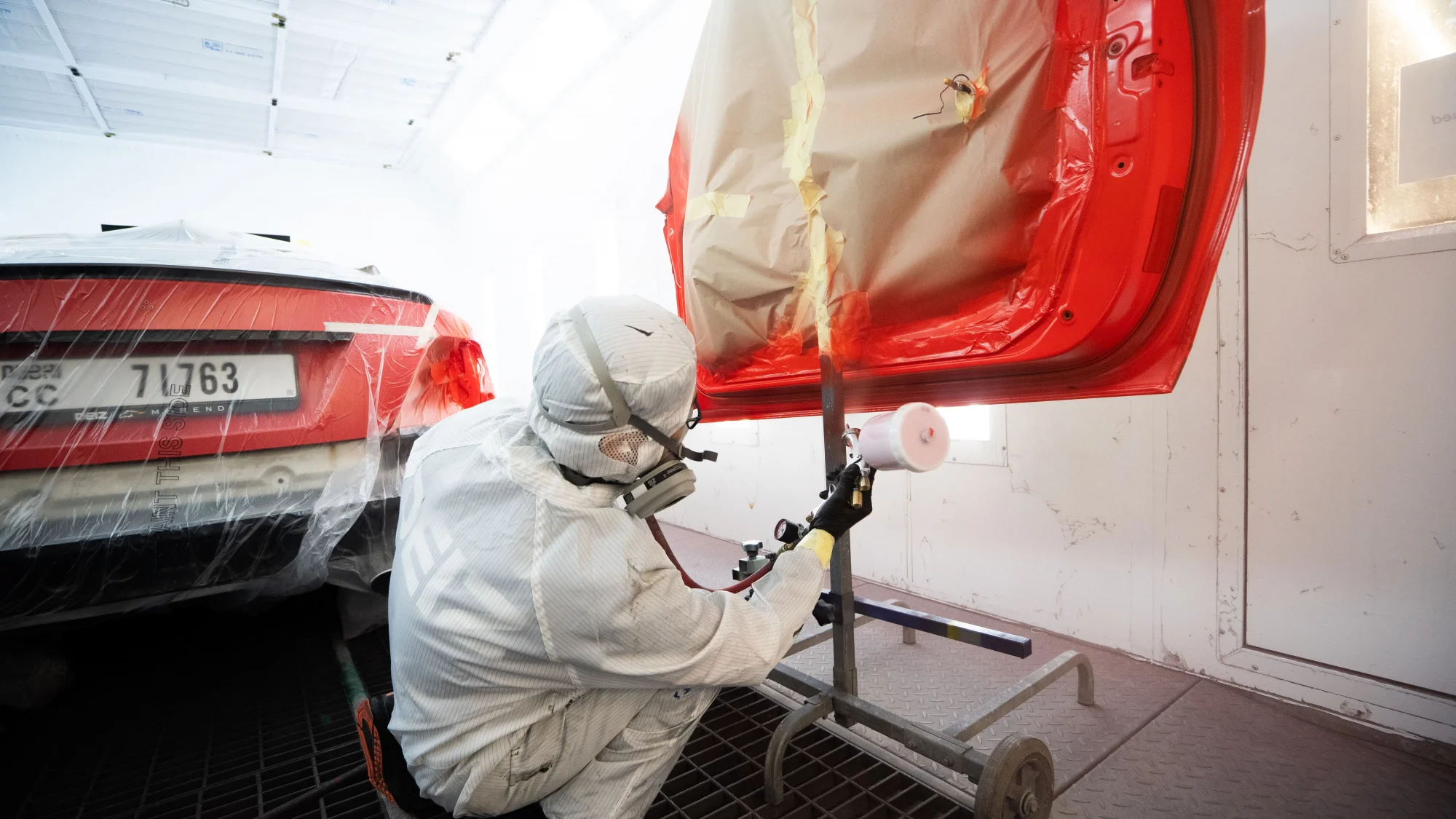
Technical capability is demonstrated by process control, not by a paint brand displayed on a wall. Check how the workshop inspects, prepares, matches colour, applies materials, cures the finish, and performs final inspection. BMW and Mercedes may use metallic, pearl, matte, or multi-stage finishes. That determines the repair sequence.
DEIZ GARAGE states that its maintenance and diagnostics work follows manufacturer procedures. For body and paint repairs, confirm which procedure applies to the vehicle, who performs the work, and what evidence of relevant training or certification can be provided. Also confirm whether each repair stage is performed in-house or by another provider.
| Stage | What the workshop should explain | Why it matters to the owner |
|---|---|---|
| Inspection | How damage depth and panel condition are identified | This determines the repair method |
| Preparation | How adjacent areas are protected, defects removed, and the surface prepared | Preparation affects adhesion and finish quality |
| Paint matching | How paint code, actual shade, and adjacent panels are considered | The paint code does not always equal the visible shade |
| Material application | Which materials are compatible with the existing finish and panel material | Plastic, metal, and previous repainting require different approaches |
| Curing and inspection | How gloss, colour, blend edge, and surface cleanliness are checked | Final appearance depends on inspection after painting |
Where disagreements usually begin
Disagreements usually arise not from the scratch itself, but from different understandings of the repair scope.
- The owner expects polishing, while inspection shows colour-layer damage.
- The written estimate states localised repainting but does not explain whether colour blending is included.
- The price includes paintwork but does not separate preparation, trim removal, or refitting.
- The customer expects complete invisibility, while the condition of an adjacent panel or previous repainting affects the achievable result.
- Warranty is discussed verbally, but its terms do not appear in the documents.
This is why one simple discipline matters: confirm the method before work begins. Not "touch up the door", but the specific scope, materials, repair area, and approval process for changes.
Compare scratch-repair quotes line by line
Comparable written estimates must describe the same repair method and the same repair area. If one workshop proposes polishing and another proposes localised repainting, the totals cannot be compared fairly. They are different services with different outcomes and risks.
A written estimate is a document that separately identifies work, materials, payment terms, and the agreed repair scope.
Request a clear scope, written estimate, and timeline. The final estimate should depend on the confirmed repair method, panel condition, and paint condition. Do not choose solely by the total price: confirm that the repair method, preparation, materials, paint transition, warranty, and documented scope are comparable.
| Written-estimate item | What should be stated | Comparison question |
|---|---|---|
| Inspection | Assessment and agreement on panel condition | Is it included in the final scope? |
| Preparation | Cleaning, sanding, masking, and possible priming | Is the preparation level the same in both estimates? |
| Work | Polishing, SMART repair, localised repainting, or full-panel repainting | Which exact method is proposed? |
| Materials | Paint, clear coat, primer, and consumables | Is compatibility with the existing paint system stated? |
| Paint matching | Colour matching, shade testing, and blending | Is blending into an adjacent area included if required? |
| Reassembly and finishing | Removal and refitting of trim, final finishing | Which parts will be removed and refitted? |
| Taxes and additional charges | Applicable charges and conditions for extra work | What could change the final amount? |
| Warranty | Coverage, duration, exclusions, and claim process | Are the terms confirmed in writing? |
Do not accept wording such as "scratch repair, total price". It does not show whether the workshop will perform polishing, SMART repair, or repainting. A useful written estimate shows the difference without requiring the customer to read between the lines.
How to proceed when estimates differ
First, send all workshops the same photographs and damage description. Then ask each one to state the proposed method. After inspection, compare only written estimates that match in panel, repair area, and expected result.
If one estimate is lower, ask one question: "Which operation is excluded compared with the other estimate?" Sometimes the answer will be reasonable. Sometimes it will show that the documents describe different work.
Require a transparent process and documented results
Documentation protects both parties. Pre-repair photographs record the original condition. Approval after diagnosis confirms the scope. Photographs and inspection at handover allow the result to be assessed in consistent lighting, rather than from memory a week later.
Request a written process covering inspection and diagnostics, scope, estimate, timeline, preparation, repair, finishing, final quality control, and handover briefing.
What to request before, during, and after the work
Before repair:
- Photographs of the damage and adjacent panels.
- A recorded description of the scratch and panel condition.
- A written estimate identifying the repair method.
- A process for approving additional work.
- Vehicle acceptance and handover timing.
During repair:
- Confirmation if the agreed scope changes after preparation.
- An explanation if localised work must be replaced by full-panel repainting.
- Approval of any changes before they are performed.
At handover:
- Inspection of the panel in daylight or neutral lighting.
- Photographs of the result from a distance and close up.
- A detailed invoice.
- Warranty documentation and aftercare guidance.
Do not request an "ideal result" as an abstract promise. Ask to see the result on the specific panel: visual colour consistency, gloss, absence of a noticeable transition, and condition of adjacent components.
Verify warranties and UAE consumer protections
A workmanship warranty should be documented in writing before the vehicle is handed over for repair. It differs from the vehicle manufacturer warranty: a workshop workmanship warranty applies to the completed repair and materials used, not automatically to the entire BMW or Mercedes.
A workmanship warranty is a workshop commitment to correct defects in completed repair work within stated terms and conditions.
For Wrapping & PPF, DEIZ GARAGE lists warranties of up to 10 years depending on the work. Confirm the exact term, covered material, exclusions, maintenance conditions, and claim procedure in the written estimate. Do not assume that a Wrapping & PPF warranty applies to paintwork. Any paintwork warranty should be confirmed as a separate, job-specific written term.
What the warranty document should include
- Which work is covered by the warranty.
- Which materials are included.
- When the warranty period begins.
- Which exclusions apply.
- How to submit a warranty request.
- Which documents and photographs must be retained.
- Who arranges a repeat inspection.
Keep the written estimate, job card, invoice, warranty document, pre-repair photographs, and handover photographs. These records are useful for clarity if questions arise about the finish later.
For current information about consumer rights and complaint procedures in the UAE, check the official consumer-protection channel in the emirate where the service was performed. Procedures and document requirements may change, so a legal position in a specific dispute should be confirmed through an official source before a complaint is submitted.
Check reputation through reviews and repair evidence
Google Reviews are useful when read by subject rather than average rating. Five-star feedback for an oil change does not demonstrate the quality of localised repainting on a door. Equally, one emotional review without details does not explain how a workshop handles paint matching or warranty questions.
Look for recent reviews mentioning BMW, Mercedes, scratches, paintwork, colour matching, timing, handover quality, and the workshop's response to concerns. Repeated details matter. They provide more evidence than a single memorable comment.
How to assess repair photographs
Do not look only at a polished after image. Check whether the damaged area is visible before repair, whether the same panel is shown after the work, and whether photographs were taken in different lighting. If a workshop shows BMW or Mercedes vehicles, identify the actual scope: polishing, SMART repair, localised repainting, or full-panel repainting.
DEIZ GARAGE also describes in-house production capability for forged wheels, high-performance downpipes, and carbon-fibre or composite aero and body elements. This may indicate internal manufacturing capability, but it does not replace evidence of scratch repair work. For this decision, ask for paint-repair examples and a documented bodywork process.
Ask the workshop: "Can you show a BMW or Mercedes scratch repair with a similar colour and damage location?" That is a normal question. An answer such as "we have many projects" without relevant examples does not provide evidence of experience with comparable scratch repairs.
Make the final choice before authorising repair
Authorise repair only when the damage, method, workshop, written estimate, documentation, and warranty are clear. The most expensive option is not automatically the right one. The best-supported option is the one with a suitable method, defined scope, documented checks, and written warranty terms.
Follow this final sequence:
- Confirm scratch depth through inspection.
- Check that the proposed method matches the type of damage.
- Verify the workshop's BMW and Mercedes experience.
- Compare written estimates line by line.
- Confirm that colour matching, preparation, and finishing are included in the document.
- Request photographs and a process for approving changes.
- Obtain warranty terms in writing.
- Keep final confirmation of scope, timing, and cost before handing over the keys.
Stop the approval process if there is no written estimate, no stated repair method, no warranty terms, or no explanation of how the result will be checked. This is not excessive caution. It is basic vehicle-owner discipline.
What to expect when booking scratch repair
Begin by booking an inspection and sending photographs that show the whole panel, the scratch from close range, the damage in daylight, and the defect from an angle. Include the BMW or Mercedes model, body colour, panel location, and any known previous repainting, wrapping, or paint-protection film.
The workshop should inspect the vehicle before confirming the repair method. After diagnosis, request a written estimate that identifies the repair area, preparation, materials, paint matching, finishing, warranty terms, and expected timing. If preparation reveals hidden damage or changes the proposed method, the workshop should obtain approval before carrying out additional work.
At handover, inspect the repaired panel in daylight or neutral lighting. Retain the final invoice, photographs, written warranty, aftercare instructions, and confirmation of the completed scope.
FAQ
How should BMW and Mercedes owners compare scratch-repair quotes?
Compare the repair method, preparation, materials, colour matching, paintwork, finishing, documentation, and warranty. Two estimates are not directly comparable if one includes polishing while the other includes localised or full-panel repainting.
When is polishing suitable for a scratch?
Polishing is suitable when the defect is limited to the clear coat and does not affect the colour layer. If primer, plastic, or metal is visible, or a fingernail clearly catches on the scratch, inspection is required to select another method.
What is SMART repair?
SMART repair is a local repair of a limited area. It does not suit every scratch: damage on an edge, body line, or wide area may require localised repainting or full-panel repainting.
Does a deep scratch always require full-panel repainting?
No. The decision depends on depth, area, panel shape, scratch location, and whether an invisible transition can be achieved. The workshop should explain why it recommends localised repainting or full-panel repainting.
Does ceramic coating repair an existing scratch?
No. Ceramic coating does not repair existing paint damage. Scratch repair must be completed first, after which a protective treatment can be considered if required.
Which documents should be retained after repair?
Keep the written estimate, job card, invoice, pre- and post-repair photographs, warranty terms, and aftercare instructions. These documents support final inspection and any future warranty request.
