Choose a restoration service for a style-change project based on its ability to deliver the specific work, not on polished photographs or the lowest figure in the first message. The owner should define the future look of the vehicle, technical changes, the acceptable level of reversibility, and UAE requirements for modifications before contacting a workshop. This makes it possible to compare proposals using the same logic: scope of work, materials, process, responsibility, timeline, and handover conditions.
A restoration service is a workshop selected for comprehensive vehicle restoration or alteration, including bodywork, paint, interior, components, electronics, and related technical work.
Style-change restoration is a project that changes a vehicle's visual or functional specification. It differs from routine maintenance and from local scratch repair on a single panel.
The principle that "more expensive means better" rarely works here. A sound choice depends on three things matching: the vehicle's starting condition, the intended style, and the workshop's demonstrated competence in this type of work.
Project first. Workshop second.
Define the project before choosing a restoration service
A restoration service should be selected for a clearly described style-change project. An owner of a premium sedan, supercar, classic coupe, or collector vehicle may want a visually similar result, yet the technical risks, originality requirements, and acceptable methods will be different.
For a modern luxury or sports vehicle, component compatibility, preservation of factory electronics, paint quality, and correct interior assembly matter. For a classic vehicle, preserving original parts, body geometry, historical character, and the option to return the car to its original specification may take priority.
A collector vehicle requires separate discipline. Not every original part should be replaced simply because it looks old. For a collector vehicle, document whether patina will be preserved or refinished, taking provenance, originality, and the ownership plan into account.
What counts as a style change
A style change can be purely visual, functional, or mixed.
A visual style change includes a new colour, protective or styling film, interior retrim, wheel design, aerodynamic elements, and exterior accents.
A functional style change affects vehicle characteristics: exhaust systems, suspension, brakes, electronic calibration, cooling, audio, or other technical systems.
A mixed project combines both directions. A new body concept may require different wheels, ride height, aerodynamic elements, exhaust changes, and electronic calibration. This is where a quote grows, not because of "premium status", but because the work is interconnected.
What to include in the first brief
The first message to a workshop does not need to be a design album. It does need a clear project brief. It helps remove services that are strong in local paint repair but do not manage complex style-change restoration.
State:
- make, model, year, and current specification;
- starting condition of the body, interior, and mechanical systems;
- desired visual result;
- mandatory changes;
- components that must be retained;
- desired reversibility of modifications;
- intended use of the vehicle;
- requirements for timeline, budget, and work documentation;
- the need to verify whether changes are acceptable for use in the UAE.
How the vehicle category changes workshop requirements
| Vehicle category | What usually determines the choice | What to request from the workshop |
|---|---|---|
| Modern premium vehicle | Preservation of electronics, finish quality, paint accuracy | Diagnostic process, work with electronic systems, material specification |
| Luxury vehicle | Interior quality, material selection, assembly precision | Retrim examples, material samples, defect-correction terms |
| Sports vehicle | Compatibility of visual and technical modifications | Evidence of work with aero, exhaust, suspension, and calibration |
| Supercar | Risks to expensive body components and factory systems | Disassembly process, parts storage, quality control, and handover process |
| Classic vehicle | Originality, body geometry, component preservation | Photo-documentation plan, removed-parts register, approach to reversible changes |
| Collector vehicle | Historical value and future marketability | Written decision on preserving original components and project documentation |
The same colour can be a simple task on one vehicle and a complex task on another. The difference is determined by body condition, coating type, extent of disassembly, and required finishing standard.
How to evaluate a restoration service before adding it to a shortlist
Choose a restoration service using five groups of criteria: relevant experience, technical capability, materials, project management, and written responsibility. If a workshop cannot explain how it moves from diagnosis to delivery, its proposal cannot be properly compared with another.
The process matters because it determines how manageable the project will be. Diagnostics reduce the risk of undiscovered issues, a clear scope of work limits disputed extras, and final control establishes the delivery standard.
Workshop evaluation criteria
| Criterion | What to check | What counts as an adequate answer |
|---|---|---|
| Experience with the vehicle | Make, class, generation, body type | Comparable completed projects are shown |
| Experience with the task | Painting, Wrapping & PPF, interior retrim, aero, tuning, custom fabrication | The method for your specific task is explained |
| Technical capability | Diagnostics, manufacturing, installation, finishing | The stages and responsible person are identified |
| Work performed in-house | Which operations are completed internally | In-house and subcontracted work are separated |
| Materials | Brand, type, colour, texture, supplier, suitability | Materials are included in the quote or its appendix |
| Timeline management | Who manages the project and how delays are communicated | There is a process for updates and approval of changes |
| Warranty and rework | What is covered, under which conditions, and how to submit a request | Terms are provided in writing, not verbally |
| Vehicle handover | How final inspection is conducted | Acceptance criteria and a delivery briefing are defined |
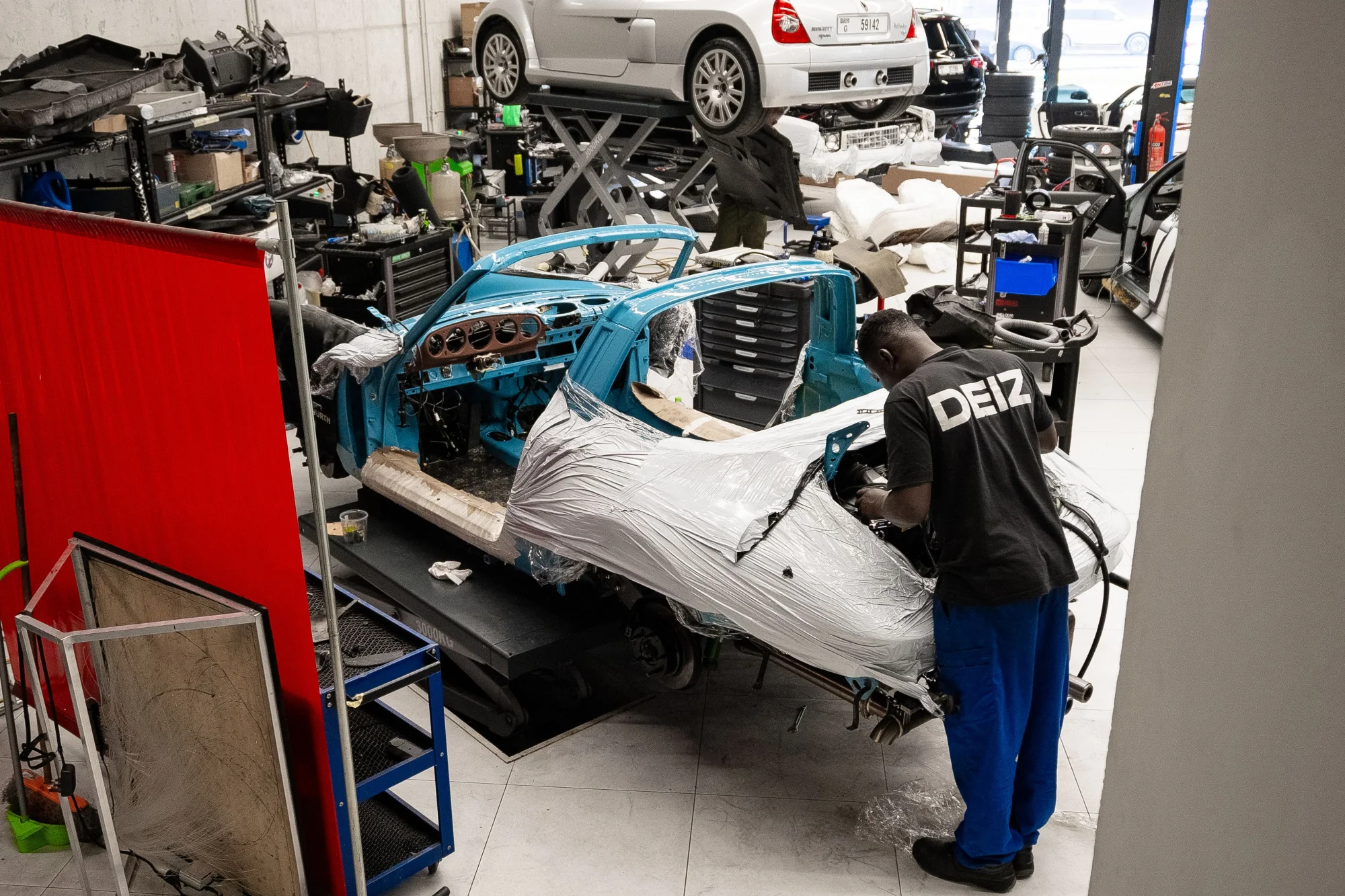
DEIZ GARAGE states that it does not subcontract work and performs all operations under one roof. For the client, this does not automatically make one operating model better than another, but it changes the responsibility structure: one provider is responsible for diagnostics, production, installation, finishing, and final quality control.
In-house production affects timing and quality control by reducing the number of vehicle handovers between providers. A subcontracting model works differently: it requires a particularly clear answer on who is responsible for the external specialist's result, timing, and later correction.
What to ask at the first meeting
Do not limit the conversation to "how much will it cost?" That question moves the discussion to a figure before the project has boundaries.
Ask:
- Which projects comparable to mine can you show?
- What will be done in-house, and what will be assigned to an external provider?
- Who prepares and approves the scope of work?
- When can the scope be refined after diagnostics or disassembly?
- Which materials will be specified in the quote?
- Who approves a replacement part, material, or method?
- How often will the client receive progress updates?
- Which warranty and rework conditions will be included in writing?
- How is the vehicle condition recorded at handover and delivery?
A good workshop does not need to promise the impossible. It does need to explain the limits of what is possible.
Portfolio evidence should demonstrate experience, not merely create an impression
A workshop portfolio is a documented project record that can be assessed by starting condition, scope of work, method, and result. A social-media feed of attractive cars is not, by itself, a sufficient portfolio.
Relevance matters more than scale. A project on a different marque does not demonstrate experience with your vehicle's body type, interior, electronics, or modification type.
What an evidence-based project should show
| Portfolio element | What the client should see | Why it matters |
|---|---|---|
| Starting vehicle | Condition before work began | Makes it possible to distinguish restoration from simple styling |
| Clear scope of work | List of completed operations | Shows what the workshop actually performed |
| Process stages | Disassembly, preparation, manufacture, installation, finishing | Helps assess technical discipline |
| Materials and components | Coating type, interior materials, parts | Allows projects to be compared by substance, not appearance |
| Technical evidence | Diagnostics, calibration, measurements, test results where relevant | Supports statements about functional work |
| Final result | Close-ups, joins, interior, details, full vehicle view | Allows the execution quality to be assessed |
| Permission to publish | Confirmation that the project can be shown | Reduces the risk of using unverified or third-party material |
When reviewing projects with before-and-after dyno figures, look beyond the final number. Check the vehicle's initial configuration, the list of changes, measurement conditions, and the link between the result and that specific project.
How to check reviews
Reviews are useful when they can be matched to a specific type of work. "Excellent service" says almost nothing about the quality of a complex restoration. Look for references to the type of work, timing, communication, corrections, and final handover.
Ask the workshop to show the project referenced in a review if the client gave permission for publication. A match in vehicle model, date, scope of work, and visual result increases confidence in the record. A mismatch does not prove a problem, but it requires clarification.
When a project can be treated as a successful example
A successful project can be used in the selection process only if verifiable information is available: vehicle category, scope of work, documented stages, and permission to publish. Without this, it remains a promotional image.
Do not accept the phrase "full project" at face value. For one provider it may mean a new film; for another, disassembly, restoration, component manufacture, calibration, and final adjustment. The words are the same. The substance is different.
Compare restoration quotes by scope of work, not by the final figure
Compare quotes only after sending the same project brief to several workshops. A quote is a written and itemised commercial proposal, not a verbal price promise in a message or over the phone.
The lowest figure may reflect less work rather than better economy. The difference occurs because one workshop includes preparation, disassembly, and final assembly, while another prices only the visible part of the task.
Quote comparison table
| Quote field | What to compare | Risk if the field is absent |
|---|---|---|
| Scope of work | Every operation, component, and vehicle area | The parties understand the result differently |
| Included work | Preparation, disassembly, installation, finishing, inspection | Necessary stages may be missing from the proposal |
| Exclusions | What is explicitly not included | Extra costs appear after work begins |
| Materials | Type, brand, colour, texture, quantity | The client cannot verify what is being paid for |
| Parts and components | New, restored, or client-supplied | Disputes arise over quality and origin |
| Third-party work | Whether it exists and who is responsible | Responsibility for timing and result is unclear |
| Timeline | Stages, dependency on supply, and approvals | Project progress cannot be monitored |
| Project changes | Who approves a change order and how | Any verbal decision becomes disputed |
| Payments | Amount, basis, and timing of each payment | Deposit is not tied to a confirmed stage |
| Warranty | Period, subject, exclusions, claim procedure | The client does not understand rework conditions |
| Approval support | What the workshop does with documents and inspection | Compliance issues remain without an owner |
How to read the difference between two proposals
| Situation | What it may mean | What to request |
|---|---|---|
| One quote is noticeably lower | It includes fewer preparatory or related operations | A list of exclusions and assumptions |
| One quote is shorter than another | The level of detail differs | Breakdown by operations and materials |
| Materials are described in generic terms | The specification is not yet defined | Exact coating, interior, or component type |
| A timeline is given without stages | There is no clear control model | Work plan and update procedure |
| Warranty is mentioned without conditions | It is unclear what is covered | Written terms and claim procedure |
| Price is stated as one figure | Vehicle class and actual scope of work are not reflected | An individual quote after inspection |
For Wrapping & PPF, DEIZ GARAGE states a warranty of "up to 10 years", depending on the work. Before ordering, request written clarification of which work is covered by this maximum period, which operating conditions apply, and how a rework request is submitted.
Change orders are where a project can lose control
A change order is written approval of a change to the scope of work, price, timeline, or materials after the original quote has been approved.
It is not needed because a workshop necessarily wants to increase the invoice. It is needed because a new colour, different interior material, additional component, or revised design changes purchasing, labour, and the project calendar.
The approval should answer four questions:
- What exactly is changing?
- Why did this change arise?
- How does it affect cost and timing?
- Who approved the decision before work began?
Without this, the project becomes a chain of conversations that each party remembers differently.
Verify UAE requirements before authorising restoration work
The legal status of a planned modification should be checked before authorising work and paying a deposit. A change should not be treated as acceptable simply because a workshop is prepared to perform it or because a similar vehicle has been seen on Dubai roads.
A modification is a change to a vehicle's construction, visual specification, or functional specification that may require review by a registration authority, inspection body, or insurer.
Requirements depend on the nature of the change, the emirate of registration, vehicle documents, and the requirements of the relevant authority. For that reason, a universal list of "permitted" changes should not be published without a current official check. This is one of those cases where confidence can cost more than a consultation.
Questions to resolve before work begins
| Planned change | What to clarify | Who should confirm it |
|---|---|---|
| Change of colour, coating, or exterior appearance | Whether the change must be reflected in registration records or inspection | Registration authority in the vehicle's emirate |
| Body elements and aero | Whether the components are acceptable for use and inspection | Relevant authority and the workshop |
| Wheels, tyres, ride height, suspension | Whether the change creates inspection or insurance issues | Registration authority and insurer |
| Exhaust system | Which requirements apply to the installed configuration | Relevant authority |
| Electronic calibration and technical modifications | Whether the change requires documentation and affects insurance cover | Insurer and registration authority |
| Lighting, tint, and body elements | Which restrictions apply on the date of the project | Official regulator |
| Change of vehicle purpose or construction | Whether separate approval and inspection are required | Registration authority in the relevant emirate |
For Chip Tuning, calibrations must be adapted to UAE fuel and UAE climate conditions.
The workshop should explain its role directly: whether it prepares documents, provides a technical description, supports inspection, or does not take responsibility for these steps. If the answer is vague, the owner should seek confirmation directly from the registration authority and insurer.
Insurance depends on declared changes. If a modification changes risk, component value, or the vehicle specification, it may affect policy terms. Do not leave this discussion until the day the car is collected.
Compliance mini-checklist
- Confirm which organisation considers modifications for your emirate of registration.
- Ask whether approval is required before work, after completion, or at both stages.
- Clarify whether the vehicle needs inspection after modification.
- Ask which documents the workshop will prepare itself.
- Obtain the insurer's position in writing if the change affects construction, value, or technical characteristics.
- Keep final specifications, invoices, and confirmation of completed work.
- Do not approve technical changes if the registration process remains unclear.
Legality is not a property of a component. It depends on the vehicle's specific configuration, current requirements, and the approval process.
Documents before the deposit protect both parties
Before paying a deposit, the owner should have a recorded vehicle condition, final scope of work, written quote, and agreed communication process. This is not paperwork for the sake of a folder. The documents determine what the workshop has agreed to do and what the client has agreed to pay for.
Pre-order checklist
| What to verify | What should be available |
|---|---|
| Starting vehicle condition | Photos, video, list of visible defects, specification, and mileage |
| Scope of work | Approved list of operations, components, and work areas |
| Quote | Written breakdown of inclusions, exclusions, materials, and payments |
| Materials | Specification of coating, interior, components, and approved substitutions |
| Client-owned parts | List of handed-over components and storage process |
| Changes | Written change-order approval rule |
| Communication | Update frequency, contact person, reporting format |
| Timeline | Stages, supply dependencies, and process for delay notifications |
| Compliance | Allocation of responsibility for approval, inspection, and documents |
| Insurance | Confirmation that modification issues have been checked |
| Acceptance | Quality criteria, comments procedure, and delivery briefing |
| Warranty | Written terms and rework process |
Record the destination of removed original components separately. They may be returned to the owner, stored by agreement, or handled differently, but the decision should be written down. For a classic or collector vehicle, this affects future value and the ability to return it to its original specification.
Selection mistakes appear in the quote, timeline, and final result
One costly mistake is choosing a workshop by the headline price without comparing the scope of work. A low starting figure looks attractive until preparation, materials, installation, additional components, or final assembly turn out to sit outside the quote.
Where risk arises before the project starts
- An undefined vehicle style. If the client wants factory originality, an extreme body kit, a modern interior, and rare custom components at the same time, the project quickly loses coherence.
- Buying components before approving the concept. Wheels, seats, or aerodynamic parts may not suit the final style, fitment, or requirements of later work.
- Comparing non-comparable portfolios. An attractive supercar photograph does not demonstrate experience in restoring a classic body or completing a full interior retrim.
- A verbal price instead of a quote. A verbal arrangement does not establish inclusions, exclusions, materials, or change conditions.
- Ignoring approval and insurance. A technically feasible modification is not automatically acceptable for registration and insurance.
- Paying without stages and change-order control. Without change control, the client loses the ability to understand what is being paid for and why the timeline is moving.
- No photo record before handover. It becomes harder to separate pre-existing defects from the result of the work.
Choose a controllable process, not a promise
Style-change restoration can be justified when the intended result matches the ownership plan, the vehicle's value, and UAE requirements, and when the workshop can document its approach. For a rare or historically significant vehicle, preserving originality may matter more than a radical new look. For a vehicle intended for regular use, a considered and reversible transformation may make more sense.
Cost depends on scope, materials, vehicle condition, and the complexity of approvals. The question is not simply whether the work is cheap or expensive. It is whether the scope is understood and whether project changes are controlled.
The choice follows a simple order: define the style, check relevant experience, review documented portfolio evidence, compare quotes line by line, resolve compliance issues, then sign the documents. Everything else is detail. Sometimes expensive detail.
FAQ
Is style-change restoration worth it?
Yes, if the project supports your intended use, does not destroy valuable originality, and can be documented with UAE requirements in mind. Rare collector vehicles require particular caution.
What matters more: a low price or a detailed quote?
A detailed quote matters more. A low figure without a clear scope of work does not show which work, materials, and risks have been excluded.
Can a workshop be selected from social-media photographs alone?
No. A portfolio should show the starting condition, scope of work, process stages, materials, and final result, not only attractive delivery photographs.
Should approval be checked before work begins?
Yes. Approval should never be assumed. Before authorising a modification, clarify the procedure with the relevant registration authority and, where necessary, the insurer.
What Wrapping & PPF price is published by DEIZ GARAGE?
Request an individual quote. Pricing depends on the vehicle class and the agreed scope of work.
What warranty is stated for Wrapping & PPF?
For Wrapping & PPF, a warranty of up to 10 years is stated, depending on the work. Obtain the written terms for the specific work and vehicle before ordering.
