
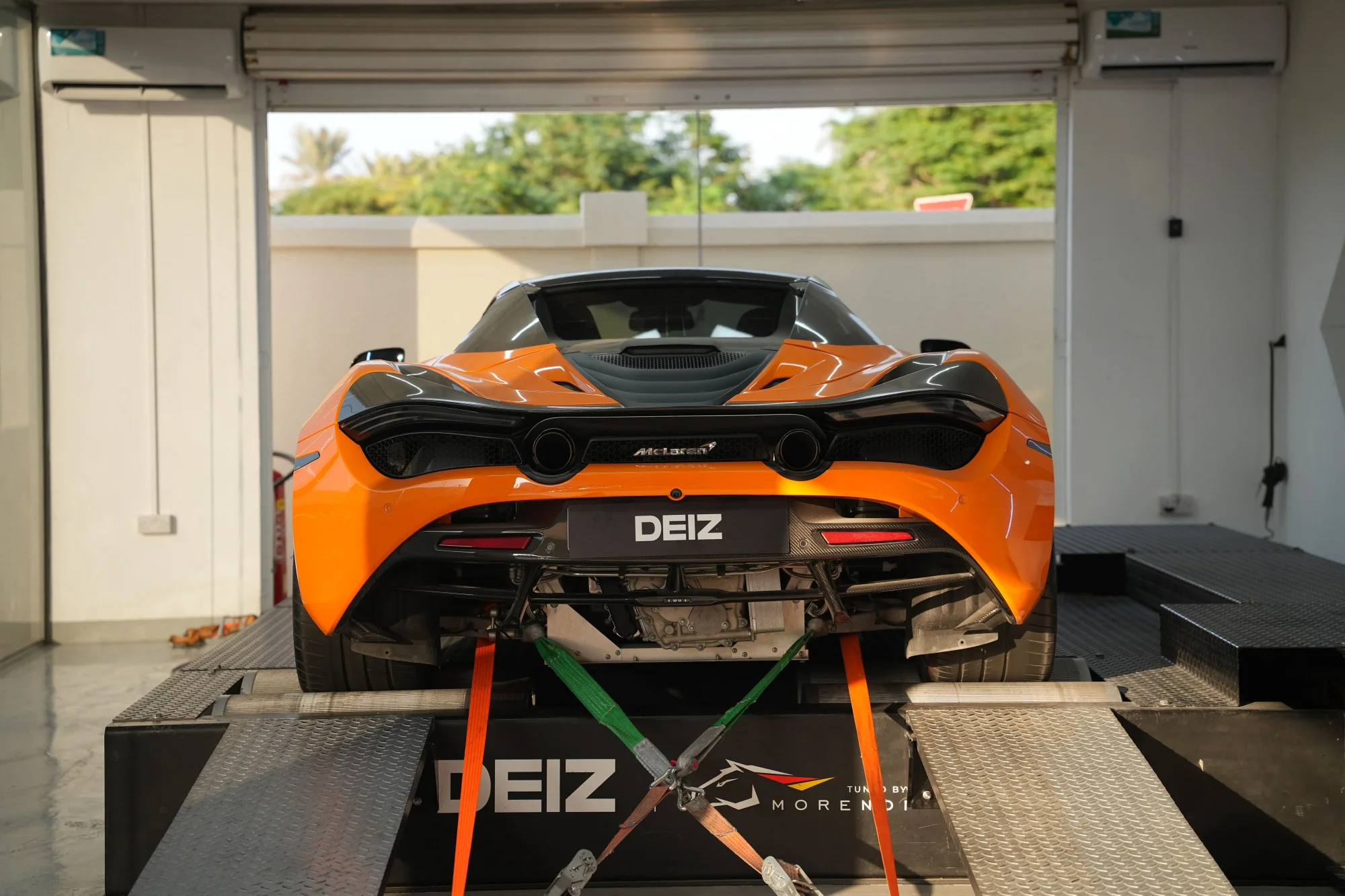
A 2019 McLaren 720S Spider arrived at DEIZ GARAGE in Dubai with 49,357 km, multiple dashboard warnings and aftermarket modifications.
The vehicle featured modified downpipes, intake and exhaust components, a third-party ECU calibration and an overrun function producing exhaust bangs.
An initial diagnostic scan revealed 120 active and historical fault codes across the vehicle’s electronic systems. A mechanical inspection identified 16 groups of findings involving the engine, transmission, suspension, brakes and electrical systems.
The objective was to distinguish genuine component faults from secondary warnings, assess the modified ECU software and restore reliable operation.
ECU Calibration and Engine Protection
The McLaren 720S uses a 3,994 cc M840T twin-turbocharged V8 producing 720 PS and 770 Nm, paired with a seven-speed dual-clutch transmission. [1]
Analysis of the existing ECU software revealed three areas requiring attention.
Ignition timing: Modified settings could affect combustion behaviour under high load, particularly in Dubai’s elevated ambient temperatures.
Knock protection: Altered or filtered knock-sensor processing raised concerns about the ECU’s ability to respond to abnormal combustion.
Overrun calibration: A pops-and-bangs function could increase exhaust temperatures and thermal stress.
These modifications justified further investigation but did not establish engine damage.
The existing calibration was reviewed and replaced with a single ECU calibration.
Because the aftermarket hardware remained installed, the vehicle was not returned entirely to factory specification.
The available documentation does not confirm the replacement calibration’s precise fuel requirement or whether every original engine-protection strategy was restored.
Diagnosing 120 Fault Codes
An Autel MaxiSys MS919 diagnostic scan identified 120 active and historical fault codes across 15 of the vehicle’s 19 control modules.
The engine control system recorded 17 faults, including historical misfires and communication errors. The transmission module contained five codes related to input-shaft speed signals and clutch temperature.
The stability-control system reported 14 faults involving communication with the engine and transmission, while the display modules accounted for 26 codes, primarily network timeouts.
Body and security systems recorded 19 faults, including battery-sensor, door-latch and gateway issues. The door modules contained 14 codes involving switches, lighting and LIN communication, while the parking system reported 12 faultsaffecting ultrasonic sensors and gear-signal information.
The remaining 13 codes concerned steering, roof operation, tyre-pressure monitoring, chassis and restraint systems.
More than half of the recorded faults involved communication between electronic modules.
A missing engine or transmission message can trigger warnings across several systems without indicating multiple independent component failures.
Key Diagnostic Codes
The engine ECU recorded P030000, indicating historical multiple misfires, together with P030500, P030600 and P030800, identifying misfires in cylinders 5, 6 and 8.
Transmission faults P2766 and P276564 indicated an input-shaft 2 speed signal outside the expected range. The scan also recorded P278700, associated with historical clutch overheating.
Two additional active faults concerned electrical and body systems: B120296 for the battery sensor and B130701 for the right-door latch.
These codes were assessed alongside the vehicle’s reported symptoms. Their presence did not automatically establish which individual components required replacement.
The diagnostic process prioritised faults associated with actual symptoms while identifying unrelated electrical issues requiring separate attention.
Misfires, Intake and Boost Control
Historical misfires were recorded in cylinders 5, 6 and 8.
The inspection also identified worn spark plugs, with replacement of all eight specified in the work plan.
However, completion of those replacements was not confirmed in the available records.
Possible causes of misfires include ignition components, fuel delivery and intake-system faults.
McLaren bulletin KA-01259 identifies intake-related problems that may contribute to power loss and misfires on the 720S family. [2]
McLaren bulletin KA-01937 recommends checking air-path sealing, wastegate operation, catalytic-converter condition where applicable, and airflow differences between engine banks. [3]
Its reference threshold of 150 kg/h airflow difference is a manufacturer diagnostic criterion, not a measurement obtained from this vehicle.
The available records do not confirm that these specific tests were completed or establish turbocharger or catalytic-converter damage.
Transmission Diagnosis and Repair
The McLaren exhibited intermittent difficulty engaging reverse gear and abnormal transmission behaviour.
Diagnostic codes P2766 and P276564 indicated an input-shaft 2 speed-signal problem.
Because the seven-speed dual-clutch transmission depends on accurate shaft-speed information for gear selection and clutch operation, the sensor and its circuit required investigation.
The transmission speed sensor was replaced, and the vehicle subsequently passed its final checks.
The diagnostic scan also recorded historical clutch overheating under code P278700.
McLaren bulletin KA-01103 V2 describes protective responses at elevated clutch temperatures:
Above 105°C: Progressive engine-torque limitation towards 100 Nm.
Above 110°C: Fault registration and neutral selection under specified conditions. [4]
These are factory thresholds, not temperatures measured on this car.
Cooling-system condition, radiator airflow and potential coolant-pump problems were relevant diagnostic considerations.
However, the available evidence did not establish internal clutch failure or a specific cooling-system defect.
Mechanical Inspection Findings
Beyond the engine and transmission, the inspection identified 16 groups of findings across eight vehicle areas.
The braking system showed worn pads and a low brake-fluid level.
Wheel and tyre inspection identified cracked tyres and wheel damage, while the steering system showed rack leakage and component play.
Suspension findings included worn arms, bushes, joints and dampers.
Engine-related observations included oil leaks, a possible oil-separator issue, dirty air filters and worn spark plugs.
The inspection also identified damaged exterior panels, carbon-fibre components and underbody elements.
Additional findings concerned historical passenger-classification faults, CAN/LIN communication errors and other body-electrical issues.
These were inspection findings, not a list of completed repairs.
The available records do not confirm that every identified issue was corrected during this visit.
McLaren bulletin KA-01744 provides relevant manufacturer guidance for assessing suspension-bush condition. [5]
Final Results
The confirmed work included reviewing the existing ECU calibration, installing one replacement calibration, investigating misfires and transmission-related faults, and replacing the transmission speed sensor.
An engine warning appeared during an intermediate road test, requiring further attention before completion.
The vehicle subsequently passed its final checks.
However, no complete post-repair diagnostic scan or final dynamometer report was available.
Therefore, the project cannot be presented as proof that all 120 fault codes were permanently resolved or that the vehicle achieved a specific power increase.
The confirmed outcome was completion of the documented software work and transmission speed-sensor replacement, followed by successful final verification.
This case demonstrates why modified supercars require a structured approach combining ECU software analysis, fault-code interpretation and mechanical inspection.
FAQ
Why did this McLaren 720S have 120 fault codes?
Many entries involved communication between control modules. A missing signal can generate warnings across multiple systems, so 120 codes do not necessarily represent 120 independent component failures.
What caused the engine misfires?
Historical misfires affected cylinders 5, 6 and 8. Possible causes included ignition, fuel delivery and intake-system issues, but the available evidence did not establish one definitive cause.
What was repaired in the transmission?
The transmission speed sensor was replaced following investigation of input-shaft speed-signal faults and intermittent reverse-gear problems. The vehicle subsequently passed its final checks.
Was the McLaren returned to factory specification?
No. A replacement ECU calibration was installed, but the aftermarket hardware remained. The exact configuration of all engine-protection functions was not documented.
Were all 120 fault codes resolved?
The vehicle passed its final checks, but no complete post-repair diagnostic scan was available to confirm permanent resolution of every recorded code.
Technical References
[1] McLaren 720S Spider — Factory Specifications. Manufacturer engine and transmission specifications.
[2] McLaren KA-01259. Intake-system and power-loss diagnostic guidance.
[3] McLaren KA-01937. Boost-control diagnostic procedures and airflow comparison criteria.
[4] McLaren KA-01103 V2. Clutch-temperature protection strategy.
[5] McLaren KA-01744. Suspension-bush assessment guidance.
The diagnostic findings, identified defects and completed work relate to this specific McLaren 720S Spider. Manufacturer references provide technical context and should not be interpreted as confirmation that every described test was performed on the vehicle.
A McLaren 720S with aftermarket modifications and numerous fault codes requires more than a basic diagnostic scan. Establishing the installed software configuration, identifying faults relevant to actual symptoms and separating inspection findings from confirmed repairs are essential to a reliable diagnostic process.
