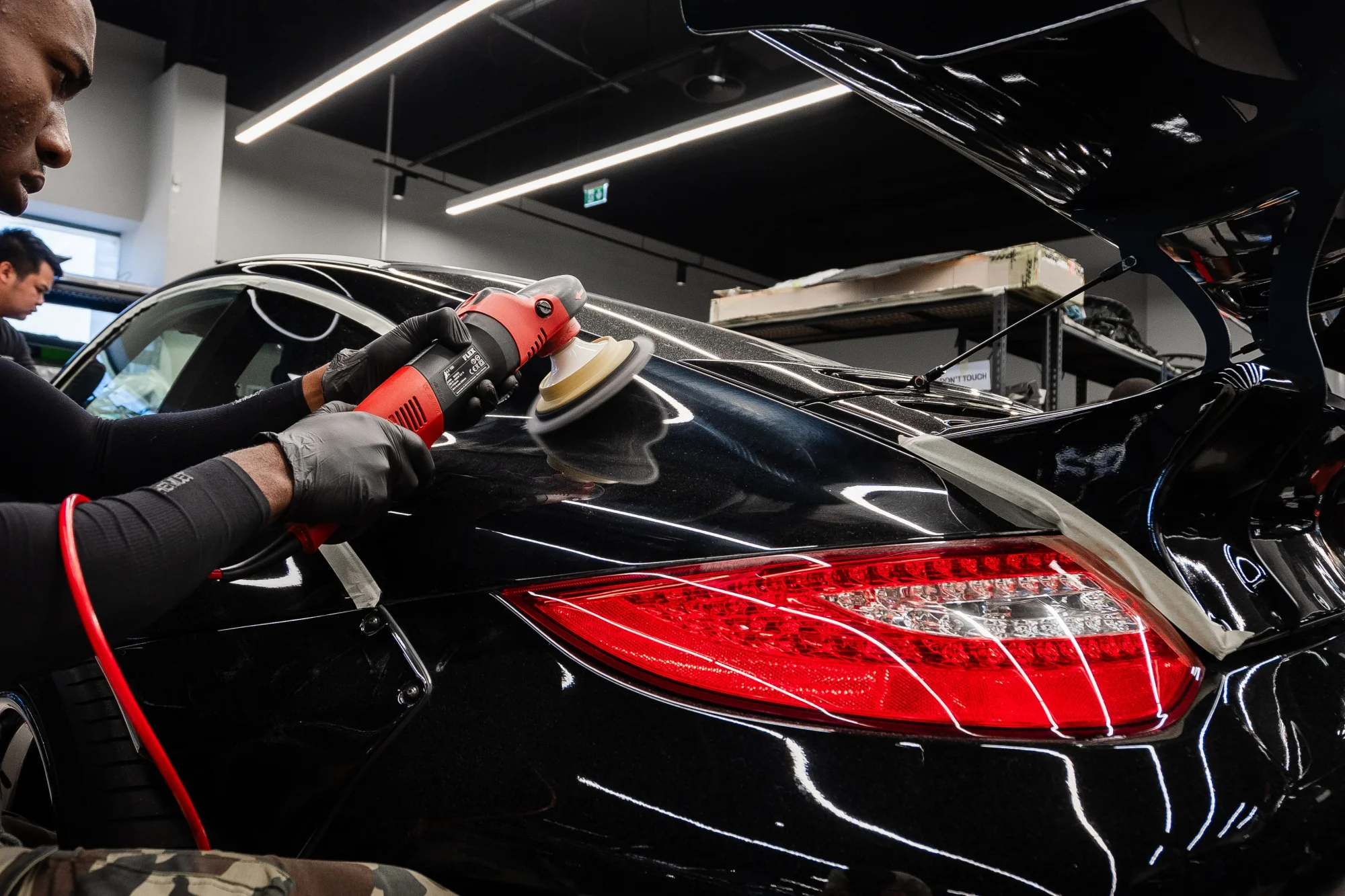
Before booking paint correction, ceramic coating, or paint protection film in Dubai, it’s important to understand the condition of your car’s paintwork. Scratches, swirl marks, previous repairs, and environmental damage can all affect which treatment is suitable. A professional paint inspection helps identify these issues and establish the right preparation and protection plan.
Why paint inspection matters before detailing
Not every paint defect requires the same treatment. Light swirl marks may be improved through paint correction, while deeper scratches or damaged paint may require repair. Ceramic coating and paint protection film serve different purposes and should be considered only after the condition of the existing finish has been assessed.
Paint-related maintenance may include:
- Paint inspection and condition assessment.
- Paint correction for suitable surface defects.
- Scratch repair or refinishing where necessary.
- Ceramic coating or paint protection film after appropriate preparation.
-
The existing paint condition should determine the scope. A protection product doesn't erase weak preparation. Ceramic coating may improve gloss and make cleaning easier, but it does not work like paint correction. Paint protection film works differently. It is applied over prepared paint, so defects, repair edges, and contamination need assessment before installation.
A provider's process should be clear before work starts. One documented sequence is:
- "Inspection & diagnostics"
- "Clear scope, estimate, and timeline"
- "Production / installation / finishing"
- "Quality control + delivery briefing"
That order stops an owner from approving coating or film installation before anyone has explained the paint already on the car.
How to assess the current condition of the paint
A useful paint condition assessment starts with a clean, dry vehicle under controlled lighting. View the car from more than one angle. Look for visible marks, but don't try to diagnose every defect from a driveway inspection. Record what you see, then ask the service provider to explain the likely cause, proposed treatment, and any limits.
Check panels in indirect daylight or inside a properly lit inspection bay. Direct sun can hide some defects and exaggerate others. A dark panel may look perfect from two metres away, then reveal circular marring under a focused inspection light. Paint has a talent for hiding its paperwork.
Look for these signs before booking:
- Swirl marks or fine circular marks seen in angled light.
- Straight scratches, scuffs, chips, or marks near handles, doors, bumpers, and loading areas.
- Dullness, staining, water-spot marks, or contamination bonded to the surface.
- Uneven gloss from one panel to another.
- Colour or texture differences that may indicate previous paintwork.
- Edges, tape lines, overspray, or irregular panel transitions.
- Lifting film, damaged film edges, or marks beneath existing paint protection film.
- Damage that catches a fingernail or appears to extend below the clear surface.
A scratch that catches a fingernail is not automatically a repainting case. It isn't automatically suitable for correction work either. It needs a professional assessment. The same applies to suspected previous repair areas, deep chips, cracking, peeling, paint lifting, and marks that may be contamination rather than surface damage.
Ask for an inspection that explains the findings
A professional paint inspection should produce more than "it needs polishing." Ask the provider to show the relevant panels, identify the defect type, explain the likely work sequence, and separate confirmed findings from assumptions.
A paint thickness gauge is a measuring device used to compare coating thickness across panels and identify variations that may need further assessment before correction work. It is not a damage detector. A single reading does not prove that a panel has been repainted.
| Assessment point | What the owner should ask | What it helps clarify before approval |
|---|---|---|
| Visual defects | "Which defects are likely to improve with paint correction?" | Whether marks appear consistent with surface-level correction work |
| Deep scratches or chips | "Which areas need scratch repair assessment rather than correction work?" | Whether repair planning should happen before protection |
| Uneven gloss or colour | "Do these panels need further diagnosis?" | Whether there may be a previous repair or finish difference |
| Paint thickness gauge readings | "Can you explain the readings panel by panel?" | Whether variations affect the correction approach |
| Existing ceramic coating or paint protection film | "What remains on the surface, and how will it be prepared?" | Whether removal, decontamination, or other preparation is required |
| Scope documentation | "Can I receive the proposed work, estimate, and timeline in writing?" | Whether the service matches the observed condition |
Prepare the vehicle before inspection or maintenance
Prepare the vehicle so the provider can inspect paint rather than the dust sitting on it. A clean surface makes defects easier to identify. It can also help distinguish contamination from damage and lead to a clearer scope.
Use this preparation checklist before a paint-condition assessment:
- Arrange a wash that removes loose dust and road film without adding fresh scratches.
- Tell the provider about bird droppings, tree residue, water spotting, fuel spills, or construction dust that affected the paint.
- Photograph visible scratches, chips, and marks before the appointment.
- Remove personal items from the boot, door pockets, and areas requiring access during inspection.
- Bring details of prior paintwork, paint protection film, ceramic coating, wraps, or repair work if known.
- Avoid fresh wax, dressing, filler product, or quick-detail spray immediately before assessment.
- Discuss whether the vehicle can be inspected away from direct sunlight.
Dubai heat and direct sunlight can distort visual assessment because glare changes how defects appear. A panel that looks clean outdoors at noon may reveal haze or marring indoors. The reverse can happen too. Inspection lighting isn't workshop theatre. It changes what can be seen.
Book a time when the provider can inspect the car under suitable conditions and explain the findings without rushing. Ask about drop-off timing, collection timing, and whether the vehicle should remain protected from dust, heat, or outdoor exposure during relevant stages of work. Those details depend on the proposed scope. They should be discussed, not assumed.
Don't spend the morning trying to hide the problem. That includes touching up scratches, applying heavy polish by hand, or covering panels with gloss products. The provider needs to see the condition as it is.
Dubai conditions that affect paint-maintenance decisions
Dubai operating conditions should form part of the paint-maintenance discussion. Heat, UV exposure, dust, and outdoor parking affect how owners inspect, clean, and protect exterior finishes. The useful question isn't which product sounds strongest. It is what the vehicle experiences week after week.
Heat and UV exposure affect paint-maintenance decisions through the vehicle's daily exposure pattern. A car stored indoors most of the time has a different operating profile from one parked outdoors for long periods. Dust affects paint condition through contact and cleaning. Wiping a dusty surface without suitable washing can add marks. Direct sun affects inspection through glare and surface temperature.
Tell the service provider:
- Whether the vehicle is usually garaged, covered, or parked outdoors.
- How often it is exposed to direct sun.
- Whether it is driven daily, occasionally, or only for events.
- Whether it travels on routes where dust, road film, or construction residue are common.
- Whether it already has ceramic coating, paint protection film, a wrap, or prior paintwork.
- How the vehicle is normally washed and dried.
Why ask all this? Protection expectations should match operating conditions. Ceramic coating and paint protection film are different choices, with different preparation and aftercare conversations. Neither removes the need for suitable washing, inspection, and maintenance.
Short version: Dubai's sun is part of the service brief.
When scratch repair should be assessed before protective maintenance
Scratch repair should be assessed before ceramic coating or paint protection film when a mark may be deeper than the surface, involves missing paint, affects an edge, or sits near suspected earlier repair work. Don't approve protection first and ask repair questions later. The work sequence can change.
Scratch repair refers to localized scratch repair intended to address a specific damaged area after the provider has assessed the depth, location, and condition of the surrounding finish. It differs from full-panel refinishing, which concerns treatment of an entire panel.
For superficial marks, ask whether paint correction may improve appearance and what result is realistic. For deeper damage, ask whether the mark needs a scratch repair assessment, whether the panel needs a different approach, and how the repair area will be evaluated before protection is applied.
| Observed issue | Discussion to have before protection | Why the sequence matters |
|---|---|---|
| Fine swirl marks | Ask whether paint correction is proposed before ceramic coating or film installation | Protection does not replace correction work |
| Light isolated mark | Ask whether correction work is suitable and what result is expected | The provider should set scope from the actual condition |
| Chip, deep scratch, or damaged edge | Request a scratch repair assessment | The damaged area may need repair planning before protection |
| Suspected prior repair | Ask for an inspection and paint thickness gauge explanation | Proposed work may need to account for variation across the panel |
| Existing film damage | Ask whether the film should be assessed before replacement or additional work | The condition beneath and around the film matters |
Ask for the repair method, affected area, preparation sequence, and the point at which the provider will inspect the result. Ask where the boundary of approved work sits. "We'll make it disappear" is not a scope. It's a sentence that tends to become expensive later.
Paint correction and repainting are not interchangeable terms. Paint correction concerns improving the existing finish. Repainting concerns applying new paint. The provider should use the right term and explain why it applies.
Match the maintenance service to the paint condition
Choose the maintenance service by matching paint condition, exposure pattern, and protection goal to a documented preparation plan. A service category should be the outcome of assessment, not the starting pitch.
Ceramic coating may be considered where paint is in suitable condition after agreed preparation. Paint protection film may be considered where the owner wants a film-based protection option on identified areas or the vehicle. Paint correction may be discussed where visible surface defects affect the finish. Maintenance-only work may suit a vehicle whose protective system and paint condition have already been assessed.
| Option | When it may be discussed | Condition question before booking | Preparation question for the provider |
|---|---|---|---|
| Maintenance service | Paint appears generally sound and the owner wants ongoing paint-related care | What is on the paint now, and what does the inspection show? | How will the surface be cleaned and assessed? |
| Paint correction | Swirl marks, haze, or other visible defects affect finish appearance | Which defects are expected to improve, and which are not? | What inspection and correction work are included in the written scope? |
| Ceramic coating | The owner is considering ceramic protection after preparation | Are scratches, contamination, or previous repair areas resolved first? | What surface preparation is proposed before ceramic coating? |
| Paint protection film | The owner is considering a film-based protection option | Is the paint condition suitable beneath the planned film area? | How will edges, existing damage, and prior protection be assessed? |
| Scratch repair | Local damage needs specific evaluation | Is this a localized scratch repair issue or something requiring a broader repair discussion? | What happens before protective work is applied? |
A works this way, B works differently: paint correction addresses defects in the existing finish, while paint protection film adds a film over prepared paint. Ceramic coating is also not paint correction. It should not be sold as one.
Those statements don't remove the need for a paint condition assessment. A 10-year warranty statement is not a universal outcome for every vehicle, service scope, or operating condition.
Questions to ask a provider before authorizing work
Ask questions that require the service provider to connect proposed work to inspected paint condition. If the answer stays vague, pause the booking. A clear scope is more useful than a long list of product names.
Paint condition and diagnosis
- What did the paint-condition assessment identify on each relevant panel?
- Which defects may improve with paint correction, and which require a scratch repair assessment?
- Are there signs of prior paintwork, existing film, or another finish variation?
- Will you use a paint thickness gauge, and can you explain the readings?
- Can you show me the areas discussed before I approve work?
Preparation, materials, and process
- What cleaning and decontamination steps are proposed before the selected service?
- What correction work, if any, is included before ceramic coating or paint protection film?
- Which materials are proposed, and why do they fit the documented scope?
- What is the sequence from "Inspection & diagnostics" to delivery?
- When will quality control take place, and what will be covered in the delivery briefing?
Scope, pricing, warranty, and aftercare
- Can I receive a clear scope, estimate, and timeline before work begins?
- What is excluded from the approved scope?
- What aftercare requirements and service limitations apply?
- What warranty applies to this specific work?
BMW and Mercedes provider-fit checks
BMW and Mercedes owners should ask about model-specific repair procedures, finish matching, and the documented service scope for their vehicle. Don't assume that a badge answers those questions. It doesn't.
Ask the provider to explain the intended process for the relevant model, concerns found during inspection, and how the proposed work will be recorded. If manufacturer guidance is relevant, ask the provider for the applicable documented guidance rather than relying on general statements.
What to check before booking paint-preserving maintenance
Complete these checks in order before confirming a maintenance service. This is the pre-booking decision framework for owners protecting paint value in Dubai.
| Step | Check | Booking decision |
|---|---|---|
| 1 | Wash the vehicle and avoid fresh gloss products or fillers | Make the paint easier to assess honestly |
| 2 | Inspect the car under indirect light or suitable inspection lighting | Record swirls, scratches, chips, staining, and inconsistent panels |
| 3 | Photograph visible damage and note where it appears | Create a clear starting record |
| 4 | Tell the provider about prior paintwork, ceramic coating, film, wraps, and repairs | Help the provider plan the right assessment |
| 5 | Describe Dubai use: outdoor parking, direct sun, dust exposure, and washing routine | Match the proposed protection to operating conditions |
| 6 | Request a paint-condition assessment and paint thickness gauge explanation where needed | Understand repair-history indicators and correction considerations |
| 7 | Separate scratch repair questions from protection questions | Confirm the correct order of work |
| 8 | Compare paint correction, ceramic coating, paint protection film, and maintenance-only options | Select a service based on condition and goal |
| 9 | Obtain a clear scope, estimate, timeline, warranty wording, and aftercare requirements | Approve only what has been explained |
No mystery package.
FAQ: Pre-booking paint-maintenance questions
How can I inspect my car's paint before booking maintenance?
Inspect a clean, dry vehicle in indirect daylight or controlled lighting. Look for swirl marks, scratches, chips, staining, uneven gloss, suspected repair areas, and damage around edges. Photograph visible concerns and ask the service provider to explain anything that cannot be identified confidently by sight.
When should I ask a provider to use a paint thickness gauge?
Ask for a paint thickness gauge explanation when panels look inconsistent, the vehicle may have prior paintwork, or paint correction is being considered. The gauge helps compare readings across panels, but it is not a damage detector and does not prove repainting history on its own.
Can ceramic coating be applied if the paint has scratches or swirl marks?
Ceramic coating can be discussed after paint condition and preparation requirements are assessed. It does not replace paint correction or scratch repair. Ask which visible defects will be addressed before ceramic protection is applied.
Which paint-protection option should I consider for a vehicle exposed to Dubai heat and UV?
Discuss ceramic coating and paint protection film against the vehicle's exposure pattern, including outdoor parking, direct sun, dust, and washing routine. Heat and UV exposure affect the decision through operating conditions. The provider should explain preparation, aftercare, and limits for the proposed scope.
How does scratch repair affect the choice of paint-protection maintenance?
Scratch repair can change the work sequence because deeper damage, chips, edges, or suspected prior repairs may need assessment before protection is applied. Request a documented repair approach before approving ceramic coating or paint protection film.
What should I ask a paint-protection provider before approving work?
Ask what the inspection found, what preparation is included, whether paint correction or scratch repair is required, which materials are proposed, what is excluded, and what aftercare applies. Request a clear scope, estimate, and timeline in writing.
How should I prepare my car before a paint-maintenance appointment?
Wash the vehicle, photograph visible defects, disclose previous paintwork or protection, and avoid waxes, fillers, or quick-detail sprays immediately before inspection. Ask for an appointment where the vehicle can be assessed away from direct sunlight.
What should BMW and Mercedes owners ask about paint-related maintenance?
BMW and Mercedes owners should ask about model-specific repair procedures, finish matching, inspection findings, and the documented scope for their vehicle. If manufacturer guidance is relevant, ask the provider for the applicable documented process.
When should paint inspection or maintenance be scheduled in Dubai?
Schedule inspection when the provider can assess the vehicle under suitable lighting and away from direct sunlight. Discuss drop-off, collection, and exposure conditions during proposed work, especially if the vehicle spends significant time outdoors.
