Choose a detailing service for a luxury car in Dubai by checking its process, not its price, location, or polished social-media videos. A suitable detailing provider explains the scope of work before booking. It inspects the vehicle, states the limits of the expected result, shows the workshop conditions, and gives warranty terms in writing. This reduces avoidable risk to paintwork, leather, decorative trim, wheels, and sensitive interior surfaces.
Detailing is professional care for a vehicle's exterior and interior using controlled materials, defined work stages, and result verification. It differs from a standard wash because the aim is not merely a clean-looking car. The provider must use methods that suit each surface.
Paint correction is work on the condition of existing paintwork, including machine polishing and paint-thickness control. It is not repainting. It is not a promise to make every panel look flawless either.
Use three questions to assess a detailing provider: can it handle comparable materials, does it have suitable working conditions, and can its quote be compared on matching scope? Everything else follows from those answers.
Detailing for a luxury car in Dubai
Detailing is justified when the owner needs controlled care for paintwork, interior materials, and trim rather than a clean vehicle at handover. Dubai dust, sand, heat, UV exposure, regular driving, and storage conditions can affect the required scope. These conditions do not make a package "premium." They make a pre-service inspection sensible.
Sand affects paintwork through contact during washing and drying. Abrasive particles can leave marks when they move across the surface. Heat changes working conditions and material handling. A light leather interior, Alcantara, matte trim, lacquered veneer, or sensitive display needs an individual assessment.
A professional detailing service is worth considering when the required result is clear:
- restore the exterior and interior without changing the paintwork;
- assess the paint condition before polishing;
- carry out paint correction where the inspection supports it;
- prepare a vehicle for sale, storage, or collection after purchase;
- apply a coating after agreed surface preparation;
- treat interior materials according to their type and condition.
Not every add-on belongs on every car. Paint correction should follow an inspection and measurements. It shouldn't appear only because it sits inside a convincing package name.
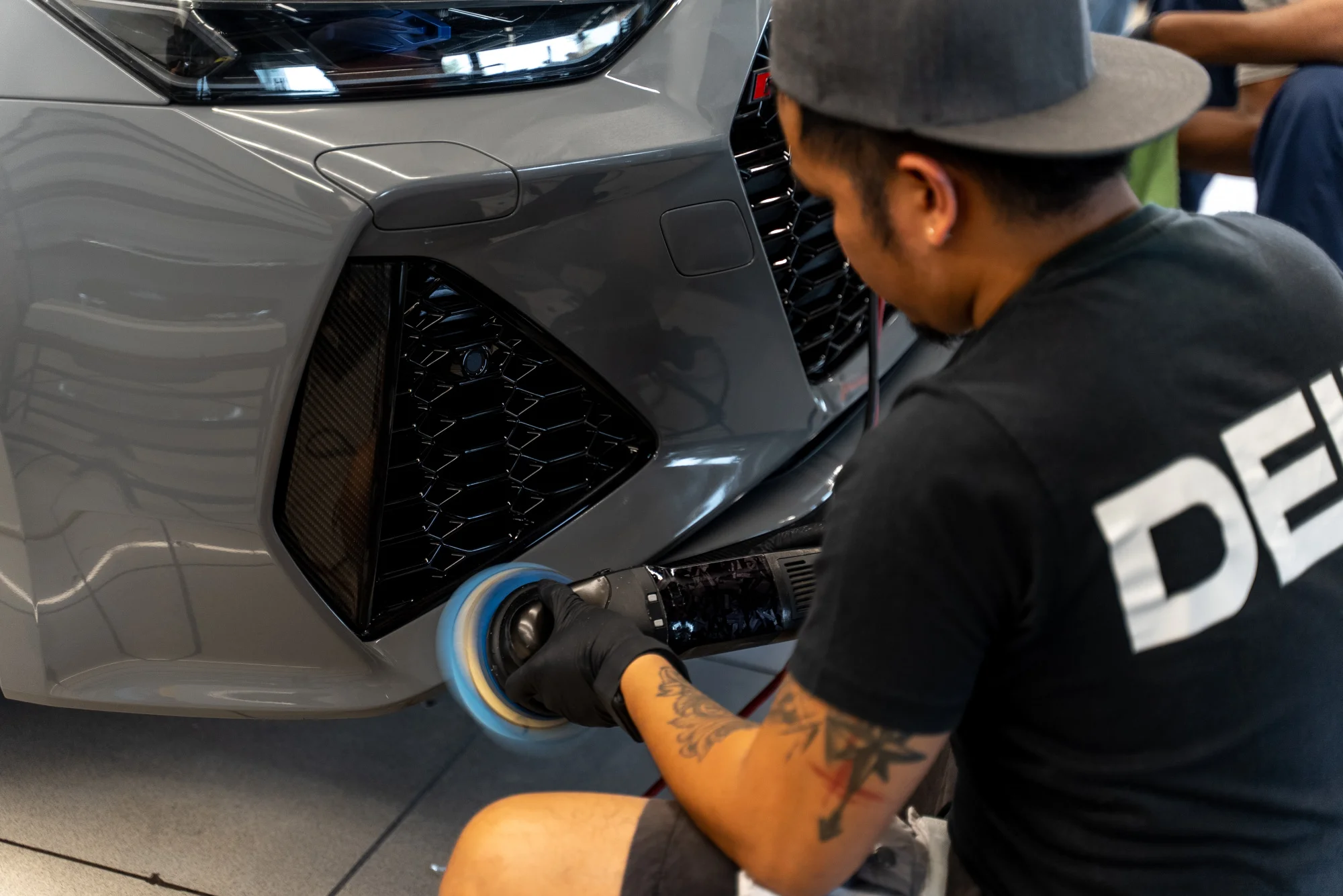
DEIZ GARAGE offers Detailing in Dubai. Its Detailing scope can include ceramic coating, paint correction, and interior-care treatments, subject to inspection and the agreed work. Its stated materials and tools include GYEON ceramic coating with a 10-year product warranty, RUPES tools for paint correction, and LEATHER MASTERS products for Heritage Care interior treatment. Use these details to ask which products and tools will be used on your vehicle, at which stages, and under what warranty terms. The final scope should still follow an inspection of the specific vehicle.
Gloss can conceal swirl marks, holograms, contamination, and uneven correction under unsuitable lighting. Direct sunlight, dust, and a quick wash can disguise paint condition for a while. The point is not to chase a showroom reflection at any cost. It is to decide what can be done safely, then confirm that the agreed work was completed.
How to shortlist detailing services for a luxury car in Dubai
A detailing studio should be able to explain its specialisation, scope of work, timing, materials, inspection process and warranty terms before booking. Broad package names or promises without a clear breakdown make quotes difficult to compare.
Start with the reason for the visit. Maintenance detailing, interior care, paint correction and coating application require different processes, so the workshop should assess the specific vehicle before promising a result.
When comparing providers, look for an itemised scope, a pre-service inspection, suitable work areas, clear information about materials and timing, written warranty terms and a defined handover process. The workshop should also explain how the vehicle will be stored and who will have access to it during the work.
A named service is not enough on its own. The important part is how the work will be prepared, carried out and checked before handover.
Minimum information before adding a provider to the shortlist
Ask each candidate the same questions:
- Which tasks are included in the agreed scope of work, and which are excluded?
- Is an inspection required before the quote is confirmed?
- Which workshop zones are used for washing, paint correction, and interior work?
- How will the original condition of paintwork and interior surfaces be recorded?
- Which materials will be used on the relevant surfaces?
- What timing applies to this specific task?
- How will the final acceptance inspection take place?
- Which warranty, rework, cancellation, and refund terms apply?
The answers expose the difference quickly. One provider may describe the finish. Another explains how it will get there. For an expensive vehicle, the second answer gives the owner something to check.
Ask for the same information in the same order. It prevents a familiar problem. One studio sends a price, another sends a package title, and a third sends a long message with no exclusions. Those are not comparable quotes. They are different starting points.
A provider doesn't need to promise the impossible. It does need to explain the next step.
How to inspect a detailing workshop before booking
Inspect the workshop when paint correction, sensitive interior work, coating application, or extended vehicle storage is planned. Photos cannot show the actual order of operations. They also cannot show towel condition, contamination control, or separation between work zones.
Climate control should be checked because temperature, dust, and humidity affect work conditions for surfaces and products. Proper lighting matters because it reveals paint defects before and after treatment. If marks are invisible under workshop lighting, they can be missed during handover.
| What to inspect | What to ask | Why it affects the result |
|---|---|---|
| Climate control | Which conditions are maintained for the planned work? | Indoor conditions affect materials and work consistency |
| Working lights | Where is paintwork assessed before and after correction? | Light reveals polishing marks, holograms, and remaining defects |
| Washing area | Is it separated from the paint-correction zone? | Water, grit, and sand should not enter finishing areas |
| Paint-correction area | Is there a separate clean space for polishing? | Paint correction needs clean materials and surface control |
| Interior-work area | Where are leather, textiles, and trim treated? | Interior work requires different organisation and products |
| Vehicle storage | Where will the car remain between stages? | Storage affects access control and condition preservation |
| Vehicle access | Who holds keys and moves the vehicle? | A clear access process reduces uncertainty during work |
The workshop should show a visible vehicle route. It starts with intake and diagnostics. Then comes the agreed scope and estimate. Production or finishing work follows. Quality control and a delivery briefing come last. DEIZ GARAGE describes this sequence as "Inspection & diagnostics," "Clear scope, estimate, and timeline," "Production / installation / finishing," and "Quality control + delivery briefing."
Ask how that route applies to your car. A stated process is useful only when it becomes specific. Where will the vehicle wait between stages? Who moves it? What happens if the inspection changes the original scope? Those answers show whether the process exists beyond a wall sign.
When an on-site visit should not be skipped
Do not skip the inspection if the provider offers paint correction without measurements. Do not skip it if separate zones cannot be shown. The same applies when existing defects are not recorded or vehicle storage cannot be explained.
Be particularly careful with pale interiors, matte elements, carbon fibre, gloss decorative panels, and complex wheel finishes. These surfaces can need different materials, lighting, or handling. A provider should say so without being prompted.
Floor cleanliness alone does not show whether towels, tools, wash areas, finishing areas, and vehicle access are controlled separately.
Disorder around towels and consumables often says more. Towels stored together without labels, loose tools near the wash zone, or unclear access arrangements do not automatically prove poor work. They do justify more questions.
The workshop visit is not theatre. It is a chance to see whether water, grit, polishing work, interior treatment, and vehicle storage are handled as separate tasks. That separation affects the result because contamination can move from one stage to another.
Equipment, products, and process checks for luxury cars
For a luxury vehicle, the label on a bottle matters less than whether the product suits the surface and is used in the right order. A detailing provider should explain how it will clean leather, glass, plastics, wheels, tyres, and paintwork. It should also explain why the selected product fits that task.
Safe washing begins with controlled contact. The two-bucket method is a practical check. One bucket holds clean solution. The other rinses the wash mitt or tool. This reduces the chance of carrying grit back onto paintwork. It doesn't make washing risk-free. It shows that the provider has considered contamination.
| Checkpoint | What to ask the detailing provider | What the customer should understand |
|---|---|---|
| Two-bucket method | Is a separate bucket used to rinse the wash tool? | How sand and dirt transfer to paintwork is reduced |
| Microfibre towels | How are towels labelled, washed, stored, and replaced? | Towels should be clean and separated by work area |
| Washing tools | What is used for paintwork, wheels, and lower sections? | Different vehicle zones need separate tools |
| Professional chemical products | Which product categories are used for which materials? | Product purpose matters more than marketing language |
| Interior products | How is compatibility with leather, textiles, and trim checked? | Surface type and condition should be known first |
| Protective products | Which preparation stages are required before application? | A coating does not replace surface preparation |
Old, contaminated, or poor-quality materials create predictable risks:
- contaminated microfibre can leave marks on paintwork;
- one tool for paintwork and wheels can transfer abrasive particles;
- an unsuitable product can alter the appearance of a matte surface;
- product residue in the cabin can leave streaks on glass, plastics, or displays;
- aggressive leather treatment can change its appearance and feel.
A useful answer may be "no" when the material or surface condition does not allow safe work. A careful specialist may refuse an unnecessary procedure if the material or surface condition does not allow safe work. That is not a weakness. It is a professional boundary.
DEIZ GARAGE lists GYEON ceramic coating, RUPES tools for paint correction, and LEATHER MASTERS interior-care products within its stated Detailing scope. Before booking, ask about the role of the product or tool in the agreed scope. A brand name alone does not describe the work.
The provider should be able to identify the product category and intended use. That is the useful question. Asking only for a brand can produce a polished answer with no explanation of preparation, compatibility, or aftercare.
But a product list is still only a list. The handling method determines whether it suits the vehicle in front of the technician.
How to assess paint correction expertise
Paint-correction expertise is shown through diagnostics, measurements, agreed expectations, and inspection after each stage. A promise to "remove all scratches" is not a technical plan. Ask which defects are present, what paint thickness is available, what may remain after safe work, and how that result will be recorded.
A paint thickness gauge is a device used to measure coating thickness before paint correction. It helps assess how cautiously a specialist can work on a particular panel. One reading is not enough. Ask how measurements are compared across different body panels.
| Paint-correction stage | What to ask | Checkable sign |
|---|---|---|
| Initial inspection | Which defects are recorded before work starts? | Photos, video, or written notes show the original condition |
| Thickness measurement | Is a paint thickness gauge used before machine polishing? | Measurements are linked to panels rather than mentioned generally |
| Result agreement | Which defects may remain after safe work? | No unconditional promise of perfection |
| Method selection | Which paint correction is proposed, and why? | The method is linked to paint condition |
| Equipment | Which professional polishing machines are used? | The provider explains the tool's intended role |
| Lighting inspection | How is the surface checked after polishing? | Working lights and final inspection are used |
| Comparable experience | Are there examples involving similar finishes and issues? | Examples describe work stages, not only before-and-after images |
DEIZ GARAGE states that it uses RUPES tools for paint correction. Turn that into a direct question: which RUPES machines will be used, which stages are planned, and how will paint condition be checked before polishing? A recognised tool does not prove the result. In the wrong hands, it is simply a faster way to make a mistake.
Questions that separate a process from a promise
Ask whether paintwork will be measured before work. Ask whether problem areas will be shown under working lights. Confirm whether the acceptable correction level will be agreed. Then ask whether existing defects will be recorded before polishing starts.
The final question matters too: what will the provider treat as a completed result? The answer should relate to the agreed scope, not to a general phrase about shine. Paint condition sets the safe limit. The safe limit determines the proposed correction level.
Paint correction and protective coating are different services. Paint correction works on the existing condition of the surface. A protective product is applied after preparation when the agreed scope includes it. Mixing both terms into one promise makes the scope unclear.
A studio that explains limitations is usually easier to assess than one that promises a perfect finish. The latter may sound more confident. It gives the owner less to verify later.
How to compare detailing quotes in Dubai
Compare detailing quotes only when they cover matching scope, matching exclusions, and comparable acceptance conditions. A price without vehicle class, work stages, timing, and warranty rules is not a usable quote for comparison.
A quote is a proposal that states the work, exclusions, timing, and price basis. A message containing only a number and package name is not a practical quote.
| Comparison factor | What should be stated | Why it cannot be skipped |
|---|---|---|
| Vehicle | Exact vehicle class and features affecting the scope | Size, condition, and materials affect labour |
| Scope of work | Stages for paintwork, interior, wheels, and glass | Identical package names can cover different work |
| Preparation | Inspection, cleaning, diagnostics, and agreed stages | The finish depends on surface preparation |
| Materials | Product category and purpose | Suitability for a surface can be checked |
| Paint correction | Expected level, limitations, and inspection method | "Polishing" does not define the result |
| Timing | Completion period and conditions that can change it | Timing should relate to the scope |
| Warranty | Duration, coverage, exclusions, and claim process | A warranty without terms cannot be compared |
| Rework | Procedure for raising concerns | This should be clear before payment and handover |
DEIZ GARAGE describes its prices as a vehicle-class ladder, not one fixed price. A price should therefore be read with two details attached: the applicable vehicle class and the agreed scope of work.
The published material includes different figures within service ladders. It does not identify the vehicle classes attached to those figures. Those unpublished class mappings should be confirmed before any price is quoted or compared. Until then, the figures cannot serve as a basis for selecting a service.
That distinction matters. A starting price is meaningful only when the provider identifies the vehicle class that qualifies for it. The same rule applies to a service with a stated completion period or warranty term. A figure without its applicable class leaves out part of the offer.
| Quote detail | What the provider should confirm | What the owner should retain |
|---|---|---|
| Vehicle class | The exact class assigned to the vehicle | The class description in writing |
| Starting price | The starting point for that class | The stated price basis |
| Additional work | Conditions that can change the agreed amount | Approval before added work begins |
| Service stages | What each stage covers and excludes | An itemised service list |
| Timing | Planned duration and reasons it may change | The agreed handover estimate |
| Warranty | Coverage for the selected work | Written warranty terms |
Do not turn a class-ladder figure into one universal price. Do not publish a starting price until the provider confirms the applicable vehicle class in writing. Writing that the price is simply "X" removes information the owner needs.
A lower figure does not automatically mean a better choice because it may exclude stages included elsewhere. Two quotes can look similar while working differently. One describes a final visual effect. The other records preparation, limitations, and quality control.
This is where many comparisons fail. Owners often compare a short message with an itemised scope, then treat both as if they describe the same work. They don't. The lower figure may be valid for its own scope. It is not a cheaper version of another service until the stages match.
Ask for written confirmation when a vehicle sits between categories, has unusual paintwork, a complex interior, or prior cosmetic work. The initial price can change because the scope changes. That is not automatically a problem. A late change without a recorded reason is.
How to verify detailing results before accepting the car
Carry out the final acceptance inspection before confirming vehicle collection and before paying any unresolved part of the work. Inspect the car under lighting that shows paintwork, glass, wheels, interior seams, and decorative trim clearly.
An acceptance inspection is the final check of a vehicle against the agreed scope of work and the recorded original condition. It differs from a workshop inspection. The workshop inspection helps select a provider. The acceptance inspection checks completed work.
| Inspection area | What to compare with the agreed scope | What to record if there is a concern |
|---|---|---|
| Paintwork | Agreed correction and cleaning result | Photo under working light |
| Glass | Cleanliness, residue, and streaking | Photo and area description |
| Wheels and tyres | Agreed work on wheels, tyres, and arches | Photo of each affected wheel |
| Exterior plastics and trim | Even treatment and no product marks | Close-up photo |
| Leather and textiles | Cleanliness, seams, moisture, and residue | Photo and cabin location |
| Panels and displays | No streaks, product marks, or damage | Photo in angled light |
| Boot and door apertures | Work included in the scope | Comparison with service list |
Short acceptance process
- Open the agreed quote and the materials from the initial inspection.
- Inspect paintwork from several angles under suitable lighting.
- Check the interior by zones, not only the driver's seat.
- Match completed work with each scope item.
- Ask for aftercare instructions and warranty terms.
- Record concerns before final acceptance.
- Keep the quote, photographs, warranty document, and correspondence.
DEIZ GARAGE lists "Quality control + delivery briefing" as a handover stage. At delivery, ask for that briefing to cover your particular car. Confirm what was done. Ask what needs later care. Request the document that confirms the warranty. Ask how to request rework if necessary.
Allow time for the handover inspection. Concerns identified before collection can be checked under the same lighting and against the original condition record.
Check the vehicle before it leaves the workshop. A concern raised on site can be shown under the same lighting and compared with the initial record. A concern raised later may still be valid, but the conversation becomes less clear.
The acceptance inspection is not an argument with the provider. It is the agreed final control point. If something does not match the scope, record it before acceptance and ask what happens next.
How to check reviews, recommendations, warranties, and policies
A useful review names the vehicle type, the requested task, timing, handover condition, and the provider's response to concerns. "Excellent service" shows how the reviewer felt. It does not confirm paint correction quality, interior treatment, or compliance with the agreed scope.
A recommendation from an owner of a comparable vehicle is more relevant than a random referral. A sports-car owner, collector-car owner, or premium SUV owner may describe materials and concerns that match your car. Even then, a recommendation does not replace your own inspection and quote.
| What to check | What to request or read | Wording that needs clarification |
|---|---|---|
| Reviews | Recent reviews naming the vehicle and service | Emotional praise with no details |
| Recommendations | Opinion from an owner of a comparable vehicle class | No description of completed work |
| Warranty | Duration, coverage, exclusions, and claim process | "There is a warranty" with no document |
| Rework | Time limit, inspection process, and correction terms | Promise to solve it "somehow" |
| Refund policy | Terms for incomplete or unprovided work | No written policy |
| Cancellation | Rescheduling, cancellation, and possible retained payment | Terms change verbally after booking |
Wrapping & PPF carries a warranty of up to 10 years, depending on the work. That wording needs a practical follow-up. Which work has which duration? What does the warranty cover? What does it exclude? How does a customer submit a request?
A warranty can be assessed only when those terms can be read and applied. The duration alone is not enough. Coverage, exclusions, evidence requirements, and the claim process determine what the warranty means in practice.
Social media can help find candidates. It is not proof of technical competence. A strong video can be shot under flattering lights. Paint condition and process depth cannot be measured from a reel.
Read reviews for useful detail, not just praise. A review that identifies the service, the vehicle, and the handover result gives the owner something to compare. A general compliment may still be genuine. It simply does not answer the technical questions.
Where owners often go wrong when choosing a provider
A common mistake is comparing sums without comparing the scope of work. Another is treating a visual marketing result as technical evidence. Both can look harmless until the owner has to establish what was promised and what was actually done.
| Mistake | What happens | How to avoid it |
|---|---|---|
| Choosing only by the lowest price | The lower quote may cover different work or exclusions | Compare quotes against the same work stages |
| Unclear price | The figure is not tied to vehicle class and scope | Request the applicable class and stated price basis |
| Skipping the workshop visit | Work zones, lighting, and vehicle access cannot be checked | Inspect before complex work is booked |
| Trusting only photos and videos | Visual content does not show diagnostics or measurements | Request process details and acceptance conditions |
| No final inspection | Concerns appear after handover | Complete the acceptance inspection before approval |
| Unchecked warranty | It is unclear when and how a request can be made | Receive written conditions before payment |
Four pricing errors deserve separate attention:
- one price stated without a vehicle-class qualifier;
- a figure quoted before the applicable class is confirmed;
- a site headline price blended with a class ladder into one number;
- the phrase "price X" where the cost depends on vehicle class.
Price should answer "for what?" before it answers "how much?" Otherwise, it is a label without a defined service.
Choosing by location, the lowest quoted figure, or photographs alone does not confirm the workshop process, scope, or acceptance conditions. That works until the car needs paint correction, a coating, or work on sensitive interior surfaces. Then the missing details return as a problem.
A provider may have a fair price and still be unsuitable for a particular task. Another may have a clear process but not be able to take the vehicle within the required period. The point is not to find a universally best studio. It is to select a provider whose documented process matches the vehicle and the job.
Booking and what to expect
A suitable detailing provider for a luxury vehicle in Dubai does not need to be the closest, the most active on social media, or the cheapest. It should show the workshop conditions, explain the work stages, record the scope, assess the vehicle correctly, and complete a final acceptance inspection.
Start with a shortlist. Visit the workshop. Request comparable quotes. Do not accept the vehicle without checking it. The process takes more time before booking. It gives the owner control where it matters.
The practical order is simple: inspect the studio, agree the scope, compare the quote, record the vehicle condition, and complete the acceptance inspection. Inspection defines the scope, the agreed scope makes quotes comparable, the condition record supports handover checks, and the acceptance inspection verifies completed work. Skip one, and the owner has less evidence when questions arise.
FAQ
How do I choose a detailing service for a luxury car in Dubai?
Choose a studio that inspects the vehicle, provides an itemised quote, shows its workshop conditions, explains materials, and gives written warranty terms.
Is detailing worth it for a luxury car in Dubai?
Yes, when controlled care is needed for paintwork, interior materials, and sensitive trim exposed to dust, sand, heat, and regular use.
How should I compare detailing quotes?
Compare matching scopes of work, including preparation, paint correction, materials, timing, exclusions, warranty terms, and rework procedure. A number without those details is not comparable.
How do I verify detailing results before accepting the car?
Complete an acceptance inspection under suitable lighting. Compare paintwork, interior, glass, wheels, and trim with the agreed quote and the recorded original condition.
What mistakes do luxury-car owners make often?
They choose only by price, accept an unclear package, skip the workshop visit, trust social media alone, and fail to confirm warranty terms before payment.
